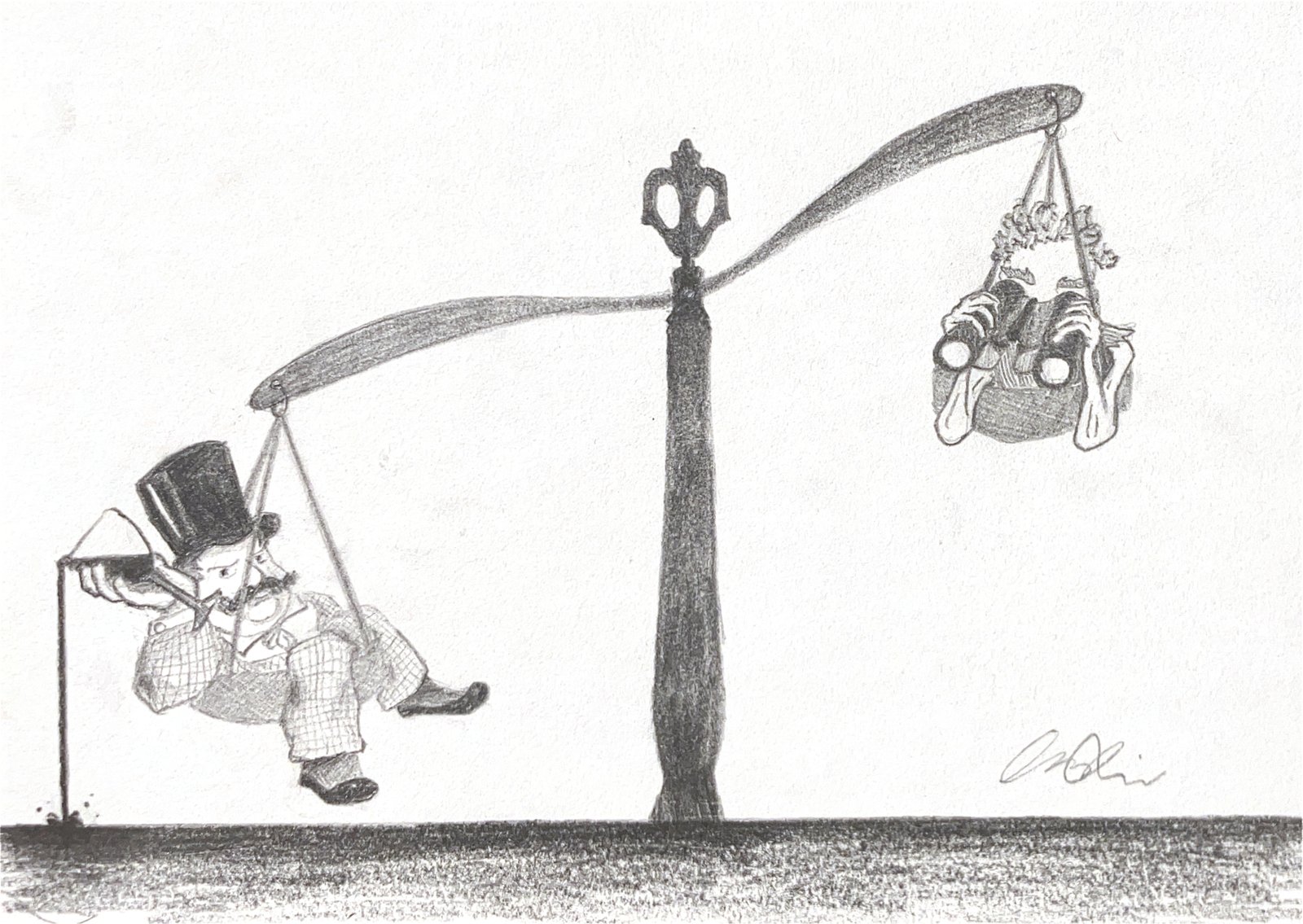
In recent years, discussions around economic inequality have grown louder. Discourse once confined to academic circles has now entered mainstream debate. In France, researchers like Thomas Piketty and Gabriel Zucman, who have been studying inequality for decades, have recently drawn significant public attention. Piketty first gained prominence with the publication of Capital in the Twenty-First Century in 2013, where he argued that rising wealth inequality is an inherent feature of capitalism and could only be reversed through political intervention. Zucman, meanwhile, has drawn national attention for proposing a 2% wealth tax aimed at reducing economic inequality and cutting France's public deficit. So, inequality has clearly become a hot topic — but why should we care about it?
The challenging case against inequality
Any argument against inequality can take one of two forms. First, one may argue that inequality is unfair, in the sense that excessive levels of economic inequality may lead to unequal opportunities and treatment among citizens. For example, inequality can act as a brake on social mobility. In France, children born to parents in managerial or intermediate professions significantly outperform those of manual or clerical workers at all school levels. 73% of them pursue higher education compared to 43% for children of manual and clerical workers. Inequality can also undermine the impartiality of political institutions. A 2016 study showed that US politicians made themselves three to four times more available for meetings with individuals when they believed those individuals had donated to their campaign. This is the deontological argument — inequality is undesirable because it is unjust.
That said, even though the deontological argument is often invoked in protests and political activism, it seems to carry little weight in mainstream policy debate. During the senatorial debates concerning the Zucman tax in France, discussion was often steered away from questions of fiscal justice toward concerns about economic competitiveness. This brings us to a second way to argue against inequality: the consequentialist argument. Under this premise, inequality is only undesirable if it produces negative consequences for society.
This line of reasoning is more difficult to sustain. One commonly invoked argument is the relationship between inequality and economic growth. In a 2003 paper, Banerjee and Duflo showed that excessive levels of inequality lead to reduced economic growth (it is worth noting that excessively low levels of inequality were also shown to be detrimental to growth). A possible explanation is that richer people underspend while poorer people don't have the capacity to spend at all, which ultimately leads to economic stagnation. But the threshold at which inequality starts being detrimental to growth is unclear. Furthermore, except for the long-term impact on growth, there is rarely discussion of how inequality can worsen people's lives in the short run.
Outpricing the poor
The main basis for this idea comes from a paper published by Gabszewicz and Thisse in 1979. In it, they develop a simple model where consumers have identical preferences — they prefer higher quality goods to lower quality goods — but differ in their income. The two researchers show that if income inequality is very high, meaning if the difference between the highest income and lowest income is very large, then price-setting firms may be incentivized to satisfy only the demand of the richest part of the population, completely excluding the poorest part from consumption.
The rationale behind this is that, if incomes are disparately distributed, firms lose out if they set a price where everybody can afford their product because they are better off by setting a high price and extracting large margins, even if some people can't afford it.
This is a serious result. If applied to a sector like healthcare, it would mean that high levels of inequality lead producers to set prices so high that medicine becomes inaccessible to part of the population.
The result is also independent from the average income in the economy: even if the poorest consumers were relatively wealthy, firms would be incentivized to set prices that are too high for them as long as the richest consumers are much wealthier.
A case study: the US
An interesting case study for this hypothesis is the United States. Despite being one of the wealthiest nations on earth, the country has become known for its high medical prices and the resulting inaccessibility of medicine. People in the US spend over $12,000 a year on their health, more than double the amount of most European countries. Insulin, which is often used as a benchmark medication to compare medical prices between countries, costs an average of $98.70 in the US, almost five times as much as in the second most expensive country, Chile, where insulin stands at $21.48.
The United States is abnormally inegalitarian if compared to similarly wealthy countries. Its Gini coefficient is the same as countries such as El Salvador and Tanzania and higher than countries like the United Arab Emirates, Somalia and North Korea. Such levels of inequality can be an explanation for the country's high medical prices. The logic would be that, in the US, income disparities are so high that medical producers have an incentive to neglect the needs of a whole section of the population in order to extract higher margins from the richest part.
What now?
Unfortunately, beyond the theoretical work of Gabszewicz and Thisse, the link between inequality and prices has been understudied in the literature. The ramifications of their argument, however, are evident. Food and medicine are two of the most basic components of human well-being. If income inequality can jeopardize their accessibility, then policy makers have good reason to tackle it. For that reason, it would be pertinent to further explore the impact of inequality on the price of essential goods.
Bibliography
A. V. Banerjee, E. Duflo. 2003. «Inequality and Growth: What Can the Data Say?» Journal of Economic Growth 9: 267-299.
Anne Brunner, Louis Maurin. 2025. Rapport sur les inégalités. Observatoire des inégalités.
J. Jaskold Gabszewicz, J. F. Thisse. 1979. «Price Competition, Quality and Income Disparities.» Journal of Economic Theory 20: 340-359.
J. L. Kalla, David E. Broockman. 2016. «Campaign Contribution Facilitates Access to Congressional Officials: A Randomized Field Experiment.» American Journal of Political Science 60: 545-558.
Joe Hasell, Bertha Rohenkohl, Pablo Arriagada, Esteban Ortiz-Ospina, and Max Roser. Economic Inequality. https://ourworldindata.org/economic-inequality
World Bank. Current health expenditure per capita (current US$). https://data.worldbank.org/
World Population Review. Cost of Insulin by Country 2025. https://worldpopulationreview.com/