Introduction
War is often understood through the experiences of the states and armies directly involved in combat. Traditional accounts focus on battlefield casualties, the destruction of infrastructure and the fiscal burden borne by belligerent governments. While these costs are undoubtedly severe, they represent only a portion of war's overall economic impact. In an increasingly interconnected global economy, conflicts generate consequences that extend far beyond national borders. Civilians, businesses, taxpayers and governments with no direct involvement in a conflict frequently bear significant economic and social costs.
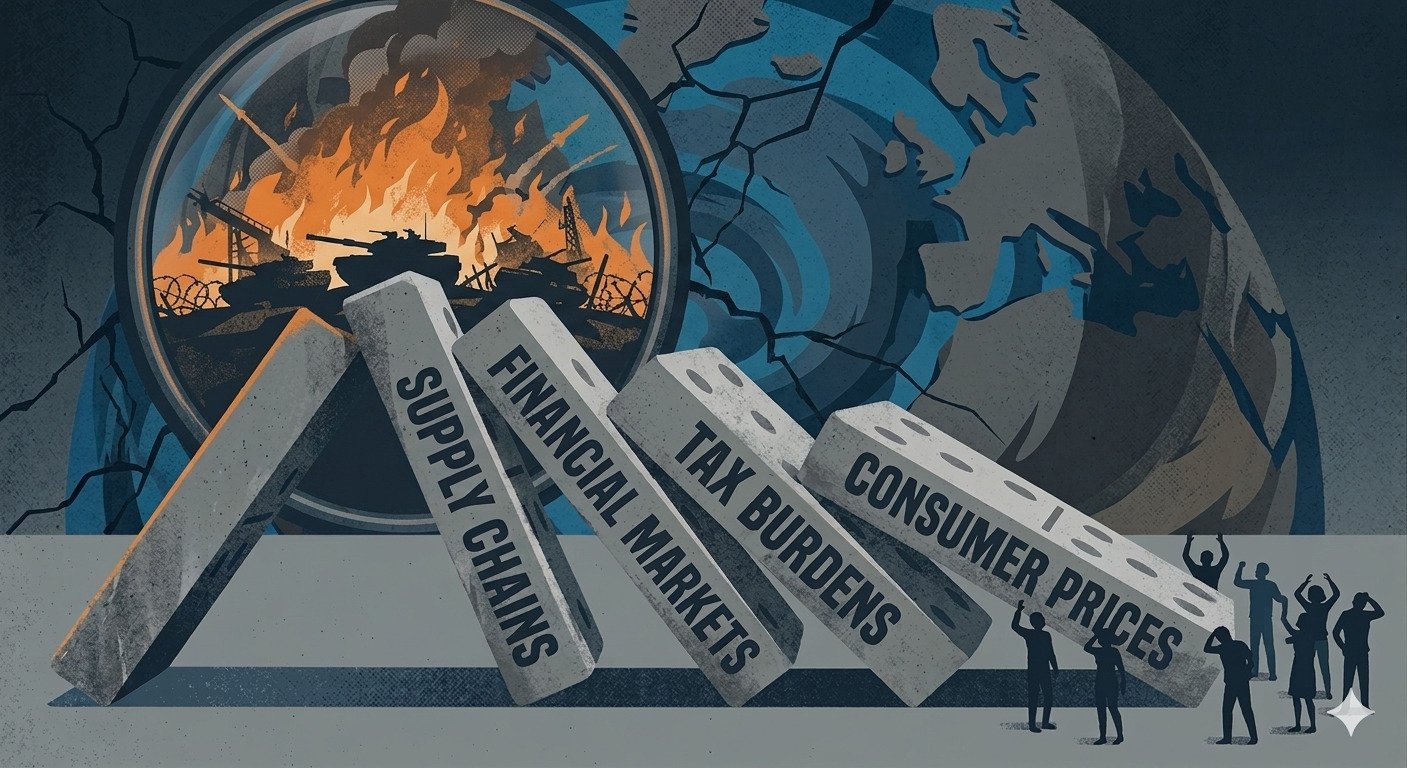
Modern wars disrupt international trade, destabilise financial markets, generate refugee crises and force neighbouring countries to divert public resources toward security and humanitarian assistance. As a result, many of the costs of war are transferred to individuals and states that neither initiated nor participated in the conflict. Understanding who pays for war therefore requires moving beyond the battlefield and examining the broader burdens imposed on these non-actors. Recent empirical evidence highlights the extent of these spillovers.
While countries experience wars on their own territory relatively infrequently, they are often exposed to conflicts occurring elsewhere through geographic proximity and economic integration. Research demonstrates that wars generate significant negative spillovers for neighbouring and economically connected countries through disrupted trade networks, financial contagion and fiscal pressures. Consequently, non-participants frequently become involuntary bearers of war's economic costs.
Supply Chain Shock and Logistical Invalidation
International trade serves as one of the main channels through which the costs of war are transmitted. Following the break of hostilities, the war-site undergoes a severe domestic contraction. It typically depresses its international commerce by nearly 40%. This contraction operates as an adverse, exogenous supply-side shock for neutral trade partners. For a neutral country located near a conflict zone, real output falls by 10% while domestic inflation rises by 5% over a 5-year horizon.
This trade destruction operates through severe physical and logistical channels:
Transit Bottlenecks: Wars frequently damage transportation infrastructure or render key trade routes inaccessible. Border closures, military checkpoints and maritime insecurity increase transaction costs and delay the movement of goods. The Russia-Ukraine War provides a clear example. Although Moldova was not a participant in the conflict, its economy experienced significant disruption when access to key Ukrainian transport corridors and Black Sea trade routes was compromised, affecting imports and contributing to inflationary pressures.
Geographic Vulnerabilities: Certain countries face disproportionate costs due to their geographic position. Landlocked states and economies heavily dependent on regional transit routes are particularly vulnerable to conflict-induced disruptions. Landlocked economies experience an additional 12% drop in international trade when an adjacent neighbour enters conflict. This is due to the maritime trade corridors being compromised. The recurring tensions between India and Pakistan illustrate this dynamic. Transit restrictions, airspace closures and trade barriers have repeatedly increased transportation costs throughout South Asia. This has reduced regional economic integration and raised the cost of cross-border commerce for countries across the region (8).
Financial Contagion and Capital Market Losses
The economic consequences of war are not limited to physical trade networks. Financial markets transmit geopolitical shocks almost instantaneously across borders. Because investors continuously reassess risk, conflicts often trigger widespread changes in asset prices even in countries that are not directly involved in the fighting.
When war erupts, equity markets in uninvolved non-acting countries contract sharply due to an immediate flight to safety attitude of investors. Following the escalation of the Russia-Ukraine war, event study evidence suggests that publicly traded firms with high exposure to the conflict region suffered significant drops in equity returns, resulting in an average aggregate loss of 1.5 percentage points across third countries.
This stock market shock suppresses the real economy of non-belligerents through explicit channels:
Sector Vulnerabilities: Not all sectors are affected equally. While defence contractors and energy producers may benefit from wartime conditions, sectors such as manufacturing, technology and consumer goods frequently experience substantial losses due to increased uncertainty and disrupted supply chains.
Credit Constraints: Falling share prices weaken corporate balance sheets and reduce the value of collateral used to secure loans. As access to credit becomes more restricted, firms delay investment and expansion plans, slowing economic growth. Consequently, even businesses located in peaceful countries may face financing difficulties as a result of conflicts occurring elsewhere.
Fiscal Burdens Beyond the Battlefield
War also places significant pressure on public finances in countries that remain formally neutral. As neighbouring conflicts intensify, governments often increase spending on border security, military preparedness, intelligence gathering and emergency response measures. These expenditures frequently come at the expense of investments in education, healthcare, infrastructure and other growth-enhancing public services.
At the same time, governments are often required to address the humanitarian consequences of conflict. Refugee flows represent one of the most visible ways in which wars impose costs on non-actors. During the Syrian Civil War, neighbouring countries such as Jordan and Lebanon did not participate directly in the conflict but hosted millions of displaced people seeking refuge. The rapid increase in population placed enormous strain on healthcare systems, water supplies, housing markets and public utilities. Governments were forced to allocate substantial resources to emergency support and social services, creating long-term fiscal challenges and placing sustained pressure on public budgets.
Conclusion
The costs of war extend far beyond the combatants who initiate and fight it. In an interconnected global economy, conflict generates far-reaching consequences that are transmitted through trade networks, financial markets and public budgets. Neutral countries may suffer reduced economic growth, higher inflation, financial instability and increased fiscal burdens despite having no role in the conflict itself.
Research suggests that the global economy would be substantially larger in the absence of violent conflict, with estimates indicating that long-run global GDP may be between 12 and 15 percent higher than currently observed levels. A significant portion of this lost prosperity falls not on the perpetrators of war alone but on businesses, taxpayers, consumers and governments that never chose to participate in the conflict.
Ultimately, war is not paid for solely by soldiers and governments. It is financed, directly and indirectly, by businesses facing disrupted supply chains, taxpayers funding increased public expenditures, households experiencing higher prices and societies absorbing humanitarian crises. The burden of war therefore extends far beyond the battlefield, making non-actors some of its most involuntary victims.
Bibliography
(1) Federle, J., Meier, A., Müller, G. J., Mutschler, W., & Schularick, M. (2026). The Price of War. American Economic Review, 116(3).
(2) Assem, H. (2023). Trade and Civil Conflicts. World Bank Policy Research Working Paper No. 10465. World Bank.
(3) Martin, P., Mayer, T., & Thoenig, M. (2008). "Civil Wars and International Trade." Journal of the European Economic Association, 6(2–3).
(4) Biermann, M., & Leromain, E. (2025). "The Ripple Effect: Trade Linkages and the Stock Market Response to the Russia–Ukraine War." Review of World Economics, 161(4).
(5) Benmelech, E., & Monteiro, J. (2025). The Economic Consequences of War. NBER Working Paper No. 34389.
(6) Newiak, M. (2026). "The Economic Consequences of Conflicts." In Regional Economic Outlook: Middle East and Central Asia. International Monetary Fund.
(7) de Groot, O. J. (2020). The Global Economic Burden of Violent Conflict. Households in Conflict Network (HiCN) Working Paper No. 199.
(8) World Bank. (2018). A Glass Half Full: The Promise of Regional Trade in South Asia. Washington, DC: World Bank.