Six days after China's January 6, 2026 export ban targeting Japan, Tokyo dispatched its first deep-sea mining ship to secure rare earth elements (REE) from the ocean floor. In November 2025, Japanese Prime Minister Sanae Takaichi had declared to the European Parliament that if China attacked Taiwan and that attack posed a threat to Japan's security, the country would not hesitate to deploy its Self-Defense Forces. This declaration heightened tensions between the two countries. China, considering Taiwan part of its territory, responded with an export ban of items that could strengthen Japan's military capabilities.
The project began in 2018, after Japan discovered 16 million metric tons of REE in the waters around Minamitori Island, a small bird-shaped island located about 1,950 km southeast of Tokyo. This amount would be enough to satisfy world demand for more than 700 years. After seven years of research and a $250 million investment in the project, Japan launched its first field experiment last month and already reported up to 350 tons extracted per day. However, some are greatly concerned by this decision, as the effects of these actions on marine biodiversity are numerous.
What is deep-sea mining?
Deep-sea mining extracts mineral resources from the ocean floor at depths of 800 to 6,500 meters, where sunlight does not reach. Key deposits include cobalt-rich crusts(*) on seamounts, seafloor massive sulfides near hydrothermal vents, and polymetallic nodules scattered across the deep seafloor.
Cobalt-rich crusts, found at 800–2,500 meters, provide cobalt for batteries, platinum for catalysts, and other metals for aerospace components. Seafloor massive sulfides, at 1,000–4,000 meters, are rich in copper for electrical wiring, zinc for galvanizing(*2), and gold and silver for electronics, industrial applications, and jewelry. Polymetallic nodules, at 4,000–6,500 meters, contain manganese for steel and batteries, nickel and cobalt for rechargeable batteries, copper for electronics, and rare earth elements for renewable energy technologies and high-tech devices.
These deposits represent valuable natural capital formed over millions of years, essential for modern technology and clean energy. However, mining disrupts seafloor habitats and can impact midwater and deep-sea ecosystems. Deep-sea mining requires advanced ships, remotely operated vehicles, and heavy machinery, making it both technically challenging and environmentally sensitive.
What are the mining strategies?
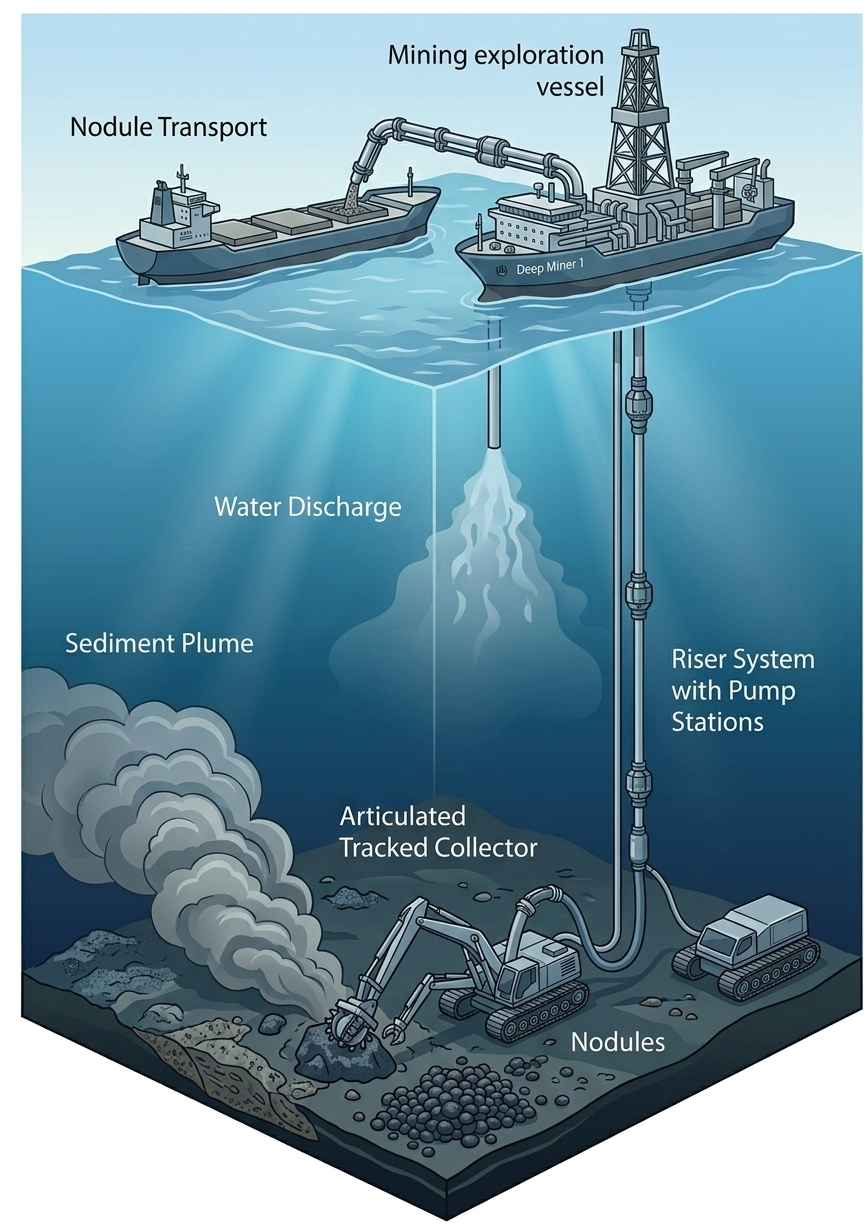
Deep beneath the ocean's surface, miners are seeking valuable metals that power modern technology. Extracting these resources requires specialized equipment. In some cases, miners use systems that lift materials from the seafloor as a liquid mixture and transport them to ships above, while returning waste deep into the ocean. This can create clouds of sediment that suffocate delicate habitats. Other approaches involve continuous lifting mechanisms that move materials steadily to the surface, causing less disturbance on flat areas of the seafloor.
Around natural mineral hotspots, robotic equipment allows for careful collection of high-value deposits, but the technology is complex and costly. In other locations, heavy machinery removes deposits directly from the seabed, producing plumes(*3) that can spread and impact ecosystems for decades or even centuries.
What are the mining strategies?
Deep-sea mining presents significant risks to both fisheries and aquaculture. Machines such as hydraulic suction, mechanical scrapers, and dredgers stir up sediment, creating clouds that cover the seafloor and make the water muddy. This can disrupt feeding, reproduction, and migration of pelagic species(*4) such as tuna and squid. Furthermore, metals released during extraction may bioaccumulate (*5) and biomagnify(*6), contaminating fish stocks and threatening commercial fisheries in high-seas regions such as the Clarion-Clipperton Zone.
Aquaculture operations, even those located far from mining sites, are not immune to indirect impacts. Contaminated water columns and polluted food webs can introduce heavy metals into farmed species, potentially affecting food safety and production yields.
Moreover, research shows that deep-sea mining can have serious effects on harvested marine life. In the Clarion-Clipperton Zone, test mining reduced the number of animals on the seafloor by about a third and caused species variety to drop by nearly the same amount. Experiments suggest that scraping the seabed in larger areas could wipe out up to 90% of corals, sponges, and other stationary creatures, while fish numbers could fall by around 40%. The clouds of sediment stirred up during mining can spread for hundreds of kilometres, covering delicate organisms and making the water muddy. These plumes can last for weeks or even months, disturbing tiny plankton at the base of the food chain and affecting life all the way up to larger fish.
Conclusion
Japan's first deep-sea mining expedition marks a major step in securing critical rare earth elements for technology and industry, particularly as tensions with China over strategic resources continue to rise. While the operation could bring significant economic and technological benefits, it also comes with serious environmental risks. The mining methods create sediment plumes, and can affect midwater ecosystems, fisheries, and even aquaculture through the accumulation of metals in the food chain. Balancing between accessing these valuable resources and protecting deep-ocean ecosystems will require strict monitoring, careful management, and international cooperation to ensure that economic gains do not come at the cost of marine biodiversity.
Bibliography
Mainichi Japan, "China Tightens Export Controls of Japan-Bound Dual-Use Items," Mainichi Japan, January 6, 2026.
McCurry, Justin, and Helen Davidson, "Japan and China in Growing Row after PM Takaichi Says Taiwan Conflict Could Trigger Military Deployment," The Guardian, November 11, 2025.
Cahill, Eva, "Japan Embarks on Its First Deep-Sea Rare Earth Mining Expedition," Oceanographic Magazine, December 1, 2026.
Jones, Tim, "Japan Says It Found Rare Earth in Sediment Retrieved on Deep-Sea Mission," The Japan Times, February 2, 2026.
Jones, Daniel O. B., Diva J. Amon, and Abbie S. A. Chapman, "Deep-sea Mining: Processes and Impacts," in Natural Capital and Exploitation of the Deep Ocean, ed. Maria Baker, Eva Ramirez-Llodra, and Paul Tyler, 91–110, Oxford: Oxford University Press, 2020.
Drazen, Jeffrey C. et al., "Midwater Ecosystems Must Be Considered When Evaluating Environmental Risks of Deep-Sea Mining," Proceedings of the National Academy of Sciences 117, no. 30 (2020): 17455–17460.
Helmons R. et al., "Dispersion of Benthic Plumes in Deep-Sea Mining: What Lessons Can Be Learned from Dredging?" Frontiers in Earth Science 10 (2022): 868701.
Peduzzi, Pascal, "Sand, Rarer Than One Thinks," Environmental Development 11 (2014): 208–218.
Natural History Museum and University of Gothenburg, "Study Measuring the Impacts of a Deep-Sea Mining Machine Finds the Abundance of Animals at the Site Decreased by 37%," press release, Natural History Museum, December 5, 2025.
Silva, Ana, "Deep Sea Mining and Its Potential Impact on Deep Sea Fish Populations and Marine Biodiversity," Journal of Marine Science: Research & Development 15, no. 2 (2025): 502.
Thomson C. et al., "Ecological Impacts of Deep-Sea Mining Waste on Marine Algae and Copepod Tigriopus californicus," Environmental Science & Technology 59, no. 38 (2025): 20190–20200.
Notes
(*) Substance that accelerates a chemical reaction by lowering the activation energy required, without being consumed or altered in the process.
(*2) Covering iron or steel with zinc to prevent it from rusting.
(*3) Columns or clouds of material that rise or spread out from a source.
(*4) Species that inhabit the open water column of oceans, lakes, or rivers, away from the seafloor and shorelines.
(*5) Gradual buildup of substances, especially toxins or pollutants like pesticides and heavy metals, in an organism's tissues over time.
(*6) Process where the concentration of toxic substances, such as pesticides or heavy metals, increases at successively higher trophic levels in a food chain.