
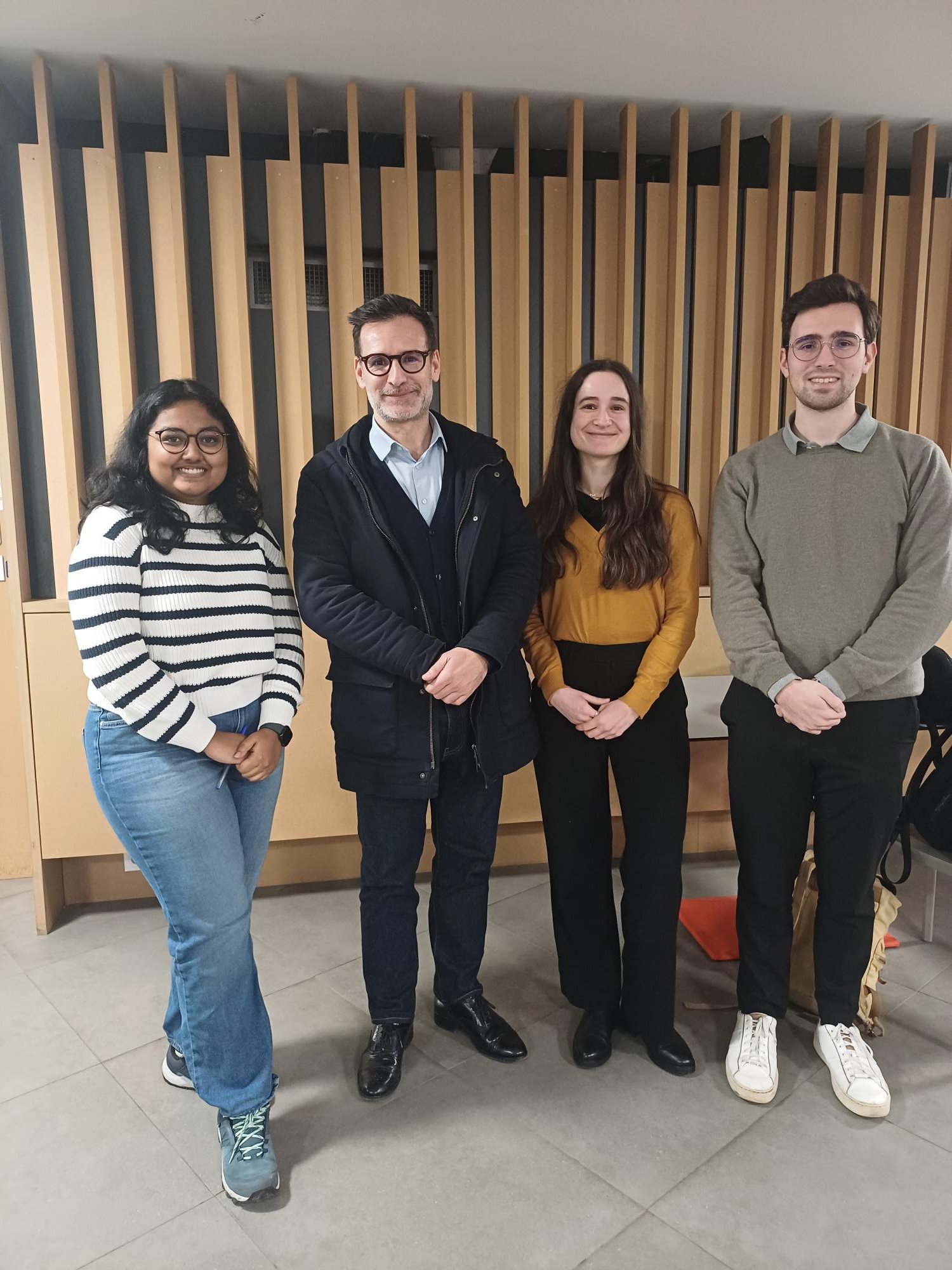
Interviewed by Klara Natek
How did you begin your career? What is the role of a biostatistician in a company like Statitec?
I started working as a biostatistician in 1998 at Statitec, a small consulting company specialized in biostatistics in support of big pharma. Here, typically, the role of a biostatistician was to define what is the best and most adapted statistical analysis to clinical protocols and to run the analysis. Once you've run the statistical analysis, you write a statistical report. That is the core activity, and for that, you need to interact with the senior biostatisticians from the pharmaceutical company.
What did your daily work look like at Statitec?
As I was starting my career, I needed some guidance from senior biostatisticians about the clinical protocol and methods that would be interesting. I also had to deal with data managers, who had to prepare the data for statisticians. In this company, unlike in a big one, the statistician was also doing this kind of data management activity. The quality of the statistical analysis depends highly on the quality of the data that you have. I also interacted a lot with medical writers, giving them statistical reports. They would then interpret our figures and analysis into medical terms, to give a diagnosis on the molecule tested during the clinical trial. At first, as I knew nothing about biology or chemistry, these interactions were both interesting and destabilizing.
What statistical tools did you use there?
I mainly used analysis of variance to identify and test the performance and efficiency of a molecule compared with a placebo. At that time, we used SAS. It was our only statistical software, because it was the only one compliant with the rules of the Food and Drug Administration.
How did the transition from a small biostatistics consulting firm to Sanofi happen? What changed in your work?
I moved from analyzing clinical trial data to research and development, which includes in vivo and in vitro protocols. Here, the scope of the activity was a bit wider. I was also in charge of the statistical protocols. At Sanofi, one specific thing was that there were thousands of scientists running experiments every week. We could not analyze all the data for the scientists. So we developed statistical tools that were adapted to their needs. Hence, I had to go to different Sanofi R&D sites in Europe to train the scientists to use these tools.
It was a really good experience in terms of human interactions with a diverse community of people, like biologists, chemists, IT developers, bioinformaticians, etc. They were all passionate and really keen to share their experiences and motivations.
What statistical tools did you use at Sanofi?
In terms of statistical methodology, I still used analysis of variance, mixed models, and something new: non-linear regressions. There is another important role of biostatisticians in designing experimental protocols: when it comes to measuring some parameter on a mouse, if you could have some non-invading ways of monitoring this specific parameter, such as the heart frequency, then if you renew it on the same individual and you use less individuals, you can improve the efficiency of your protocol. So that's where the role of the statistician was really important: to adapt and optimize the research protocols, and save mice at the same time.
Why did you move from the pharmaceutical industry to the aeronautics one?
This simply happened because Sanofi's R&D site in Toulouse closed. They asked me to move somewhere else, but I was not that interested in leaving Toulouse, and I had the opportunity to join Airbus.
How did your work change at Airbus? What was your role at first?
I joined Airbus in 2013 as a Market Research and Forecast manager. This role was completely different, but the beauty of being an economist or a statistician is that you can work in any industry. Here, I began as a market analyst to understand the dynamics of aviation markets. It could include seeing who our competitors in Latin America or Europe were. At that time, I was producing market analysis dedicated to supporting aircraft sales campaigns. Typically, if there was a sales campaign with an airline in Latin America, my role was to say that for Latin America, we see a demand for XXX aircrafts in the next 20 years. Our role was to size the market. There, many interactions took place with the sales representatives, the marketers, and also the strategists.
As I continued in this team, I moved to the Method and Tools Team to improve the statistical methodology. And in my last role in this team, I was in charge of the product studies. Before launching a new product (such as the A321XLR) or a derivative of an existing product, and investing millions in it, we have to know what the market potential for this aircraft is.
What statistical tools did you use in this first role at Airbus?
I worked a lot on time series to observe the traffic evolution in the past and to predict what it could be in the future. A bit of optimization was also needed. At this time, we used RShiny, which is a specific module that has an interface to analyze time series. We also used Python.
How did your job evolve at Airbus?
I started leading the market team dedicated to assessing the market potential for the project ZEROe. This team was also in charge of being "the voice of the customer" at Airbus, which consists in developing partnerships with airlines, getting their requirements, their concerns, their constraints and integrating that into the development of the aircraft. So we were passing the messages from the airlines to the engineering teams. Many interactions happened internally at Airbus with strategists, forecasters, aeronautics engineers, and program managers, and externally with airlines' COOs (Chief Operating Officers) who oversaw how they operated the aircraft.
What economic and operational challenges does hydrogen aviation present? What methodology did you use to estimate the cost of these challenges?
Flying with an aircraft powered by hydrogen will come with heavier aircraft. You have to put hydrogen on board instead of kerosene. The hydrogen must be in a cryogenic tank, meaning at –253 degrees so that it's compressed and takes less volumes. But given that this tank is cryogenic, it comes with additional weight. At the time we were interested in whether the future passengers would be ready to pay a little bit more to have less impact on climate. To find that out, we launched a survey with the help of some consulting companies. In terms of statistical tools, I used Excel. I am aware that it is not that good as a statistical tool, but to be honest: at that stage, I was no longer really coding.
You then took on a new role as Head of Energy and Climate Scenarios / Market Scenarios; what do these scenarios consist of?
Understanding what the different futures for aviation could be is essential to test the resilience of our Strategy. The first axis we have investigated is the Climate & Energy axis: we based our first scenarios on the Energy & Climate Scenarios proposed by the International Energy Agency and adapted them to the aviation sector. On top of assessing our business resilience, we are also able to assess the potential of the different levers to reduce aviation's climate impact, both in terms of feasibility and cost (are you ready to pay 2 or 3x more for your flight to Paris with 100% Sustainable Aviation Fuel?). Academics from research institutes such as MIT or DLR in Germany try to understand the climate impact. I'm not an expert in atmospheric physics, but you must understand a bit what's happening in the air when you burn hydrogen, kerosene, or SAF to understand the impact on climate.
In February, I've just started a new position as Head of Business Intelligence & Market Analysis and I will be happy to come back in another Business Talk to tell you more about it.