It is common for politicians to make promises and try to attract the "forgotten" masses, but it is even more common among far-right parties. They have used and channeled the sorrow of the "left behind" to build an ever growing base of supporters, appealing to them by promising a different and better economic approach than the one in place. The feeling of being understood and cared for draws the public to vote for representatives that talk about reducing inequalities for the working class. But is that really how they act? In this article we will focus on what policies far-right parties implement and what the social and economic results are, focusing on the case of Hungary.
Viktor Orbán and Hungary's inequality growth
Two studies by Csillag and Tóth (2021) show that the very nature of inequalities has changed under Orbán (2009-now). These inequalities went from being driven by skills and education, to being fueled by political connections and access to state resources, making success increasingly related to political loyalty rather than merit or productivity.
How the system works
The economists cited above show that the state renationalized sectors such as energy, utilities, and banks, and thus turned them into sources of patronage instead of public goods. These state-controlled assets were systematically distributed to a loyal network of supporters to secure political power and force economic dependence. This also helped develop a dependent middle class with an increasing portion of jobs being in the public sector. The local elites have grown richer and more powerful, controlling local communities and businesses — turning Hungary into an oligarchic state.
This phenomenon is only possible because Orbán's government previously weakened institutions such as the media, trade unions and an independent judiciary system, making it more difficult to get economic power solely based on merit.
Economic reality
As for the economic impact, Hungary became the largest net beneficiary of per capita EU cohesion funds, which were destined to help regional development but were used otherwise. It is estimated that 5% of the GDP was redirected each year to a selected few close to the government, by using subsidies and rigged public markets.
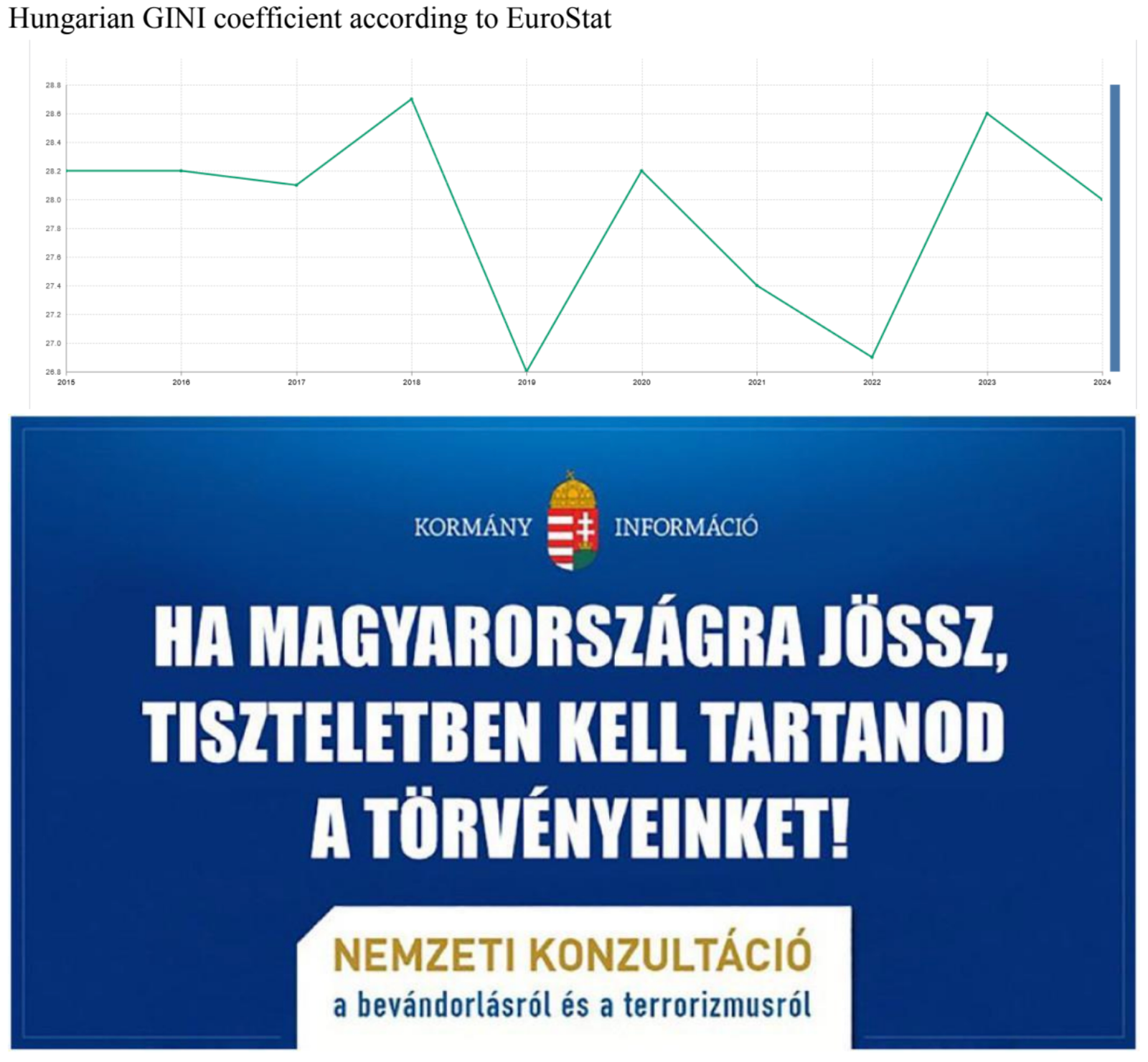
Before Orbán, Hungary's inequality level was lower than the EU average, whereas it is now above it. The Gini coefficient dropped from 27.8 in 2004 to 25.7 in the year Orbán was elected (2010), showing a decrease in economic inequalities. From 2010 to 2022 it soared to 28.3. Furthermore, the 80/20 ratio was 3.7 in 2009 and 4.4 in 2022 — meaning the revenue of the 20% richer was 4.4 times higher than the one of the 20% poorer, against 3.7 times before Orbán.
Deepening social divisions: a hidden agenda?
Ethnic minorities and migrants hatred
The government's nationalist policies have been a first step towards institutionalizing discrimination, the best example of which is the condition of the Roma minority. Reports from organizations like the European Roma Rights Center show in detail the reality in which these people live. They argue that the Roma are being segregated, with their children often being assigned to substandard schools. For example in the Borbánya district of Nyíregyháza, 80% of students were Roma. This, ultimately, results in a cycle of poverty and exclusion from the labour market. Therefore, this exclusion prevents this community from accessing positions of power and keeps them in the lower echelons of society. This is heightened by the state's xenophobic "Stop Soros" laws (2018) that criminalize aiding asylum seekers.
The government also funded campaigns putting up hundreds of posters on billboards warning migrants to "respect the culture", "obey the laws", or to "leave the jobs for Hungarians" — written in Hungarian. This campaign happened in 2015-16, when the EU asked Hungary to find homes for 1,294 refugees but Orbán's government spent 28 million euros on the campaign instead, resulting in the number of refugees granted asylum dropping from 1,291 in 2017 to 22 in the first half of 2018.
Gender and LGBT+ identities in a patriarchal state
The party's vision of the traditional family has had discriminatory consequences: financial incentives for women to leave the workforce resulted in an increase in the gender pay gap from 6.5% in 2010 to 17.2% in 2023. The LGBT+ community also faces restrictive laws. The government's strategy to ban the "portrayal or promotion" of homosexuality to minors erases them from public life. In 2022, a survey showed that 83% of LGBT+ Hungarians felt their quality of life worsened and 64% declared the political and social climate caused them psychological distress.
Worsening healthcare
Public services worsened under Orbán's government, being chronically underfunded (10.8% of the budget in 2009 to 8.7% in 2021), forcing one's well-being to be connected to their wealth and connections. The out-of-pocket cost of health spending increased from 22.4% in 2009 to 27.6% in 2021, with mortality from preventable causes increasing by 22% between 2009 and 2021. This helped develop a corrupt system where access to healthcare requires "gratitude payments" — informal bribes harming the poor most.
Conclusion
Based on the evidence collected, the election of a far-right government in Hungary has definitely exacerbated socioeconomic inequalities in the country, contradicting its populist promises for the "left behind". Under Viktor Orbán, economic policies helped rich people get richer while poor people stayed farther from power and money than before.
The increase in the Gini coefficient and the S80/20 income ratio are proof of the rise of inequalities, fueled by political loyalty and resulting in an oligarchic state. Moreover, social policies also contributed to deepening certain divisions between ethnicities, genders and sexual orientations, all the while reducing healthcare funding.
Bibliography
Csillag, I., & Tóth, I. J. (2021). The Rise of Oligarchs in Hungary: A New Form of Political Capitalism? Budapest: Institute of Economics, Centre for Economic and Regional Studies.
Scheiring, G. (2021, June 15). Viktor Orbán Presides Over a Vast Right-Wing Kleptocracy in Hungary. Jacobin.
Eurostat. (2023). Gini Coefficient of Equivalised Disposable Income.
Migration Policy Institute. "Using Fear of the 'Other,' Orbán Reshapes Migration Policy in a Hungary Built on Cultural Diversity." By Elżbieta M. Goździak, October 10, 2019.
European Roma Rights Centre (ERRC). "A Lesson in Segregation: The Borbánya Primary School Case in Nyíregyháza, Hungary." ERRC, June 14, 2022.
Hungarian Helsinki Committee. "The 'Stop Soros' Package: A Legislative Attack on Human Rights in Hungary." 2018.
Council of Europe, Commissioner for Human Rights. Report on the Visit to Hungary. By Dunja Mijatović. Strasbourg: Council of Europe, March 25, 2024.
Háttér Society and Ipsos. "The Impact of the Hungarian Anti-LGBTQ+ Law and the Political and Social Climate on LGBTQ People in Hungary." Háttér Society, June 2022.
World Health Organization. Global Health Expenditure Database. "Domestic general government health expenditure as a share of general government expenditure (%) — Hungary."