What do a balloon at a birthday party and a superconducting magnet in an MRI scanner have in common? They both rely on the same non-renewable resource: helium. While it may seem just a trivial and abundant gas, it is actually a fundamental input in several fields and there is no known substitute. Its cooling properties are the reason why fibre optic cables do not melt during their production and we are able to manufacture semiconductors.
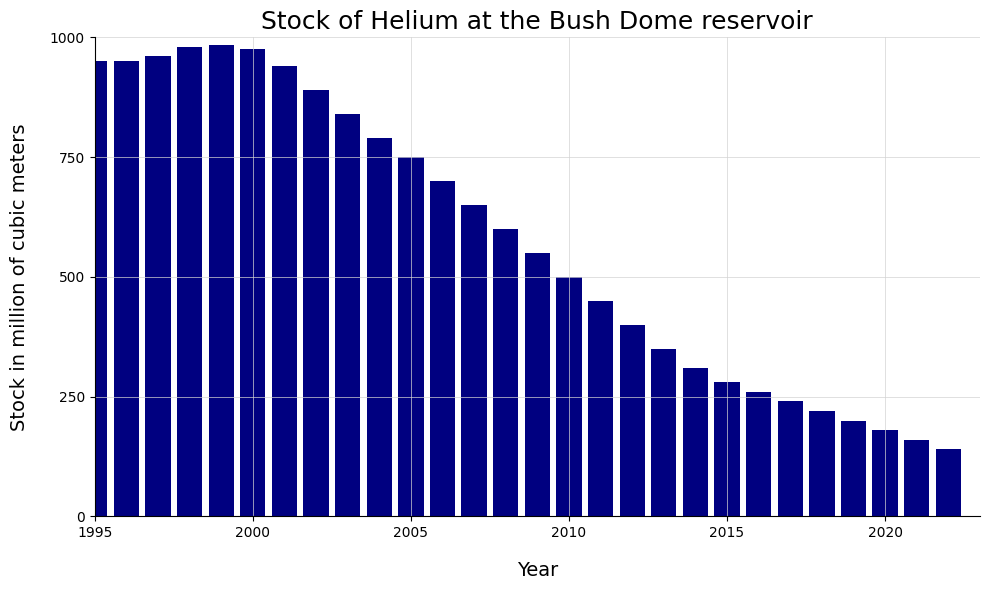
Helium is the second most common resource in the universe, but extracting it on Earth is not as easy as it may seem and we now face a global shortage. However, geology did not cause this helium crisis, a government failure did. Starting in the 1960s, the United States piled up the largest helium reserve in the world, reaching its peak of a billion cubic meters in 1995, all stocked in the Bush Dome reservoir in Texas. Nevertheless, such a large facility results in high maintenance costs and the reserve was $1.4 billion in debt in 1995. The year after, the US Congress approved the Helium Privatisation Act: a sell-off of more than 70% of the national reserve at an artificially low price to pay off the debt. This article analyses how a single policy error led to a distorted price system, underinvestment, and waste of one of the most relevant strategic resources of the 21st century.
Accounting over economics: when theory is ignored
To understand how the helium market works, we must study its unique supply-side constraint. Unlike oil or coal, companies do not drill specifically for helium. It is almost exclusively a byproduct of natural gas extraction, as it is liberated from the ground during the process. However, helium is particularly elusive and requires sophisticated separating technology during natural gas extraction, before it is vented into the atmosphere, where it escapes Earth's gravity forever. Additionally, some of the few private companies that extract helium have regional monopolies. These factors, along with a highly heterogeneous demand, make the helium market extremely volatile, and the US national reserve enhanced stability (Nuttall et al., 2012).
The 1996 privatization act, however, turned the reserve from being a stabiliser into a disruptor of the helium market. The law determined a pricing formula based not on supply and demand, but on a simple accounting equation: the fixed price was set to cover the $1.4 billion debt accumulated by the reserve, plus interest. This pricing choice was completely in contrast with Hotelling's Rule, which defines the optimal price path of a non-renewable resource. Hotelling (1931) stated that the growth rate of finite resources' prices should be equal to the discount rate, in order to maximise economic rent over the extraction period, and incentivizing conservation and the search for substitutes as the resource becomes scarcer.
The US government did the exact opposite. By computing a fixed price based on an accounting need, for two decades they sold helium at an artificially low value compared to the supply and demand equilibrium. This distorted the helium market, leading private companies, unable to compete with the US government prices, to stop exploration projects and upstream investments. Additionally, this sell-off resulted in less need for helium recycling, wasting large amounts of a strategic resource. Why invest millions of dollars looking for new deposits and better technologies when the largest supplier in the world is selling helium so cheaply?
Trading one strategic dependency for another
Fast forward to the present day, and the consequences of this policy are severe. The Federal Helium Reserve is now depleted of its stock, and the "helium cliff", as worried physicists called it, is no longer a forecast, but a reality. Global demand for helium applications in the high-tech sector surged. From AI and the need for semiconductors to the rapid expansion of MRI and medical devices that require cryogenics, helium is being demanded more and more. To moderate the severe consequences of the helium shortage, massive investments and research on technologies to increase efficiency in helium extraction and usage are required. However, in the meantime the 1996 Privatization Act is handing market dominance to the only other nations with large natural gas reserves: Qatar, Russia, and Algeria (Provornaya et al., 2022).
This shift in market power is a threat to the industrial goals of the current US administration. The economic agenda of President Donald Trump revolves around making supply chains come back to the US, with a particular attention to semiconductor manufacturing, the most critical sector for modern technological progress. Through tariffs and subsidies, the White House aims to end the US reliance on the other coast of the Pacific Ocean.
However, these objectives may find an obstacle in the helium shortage we discussed. A modern semiconductor plant consumes plenty of helium, using it for cooling materials in several processes during the production. By emptying its national helium reserve to fix the budget in the 1990s, the US government has undermined its current industrial strategy. How can the United States strengthen industrial sovereignty to "Make America Great Again" when one of the most crucial resources is increasingly controlled by geopolitical rivals? The US risks trading its dependence on Taiwanese chips for a dependence on Russian and Qatari gas.
The story of the Helium Privatization Act is a textbook example of what happens when policy decisions deviate from economic theory to serve political and accounting purposes. By selling a strategic asset for a fixed and artificially low price, the 1996 act has encouraged the wasting of a critical non-renewable resource, while dampening the private investment needed to replace it. The lesson from the helium crisis is clear: when policy artificially distorts prices and market dynamics for short-term political goals, the long-term consequences are serious. As the global economy and growth relies more and more on rare earths and critical minerals, governments must not replicate the same mistake twice.
Bibliography
Hotelling, H., 'The Economics of Exhaustible Resources', Journal of Political Economy, vol. 39, no. 2, 1931, pp. 137–175.
Nuttall, W., Clarke, R. and Glowacki, B., 'Stop Squandering Helium', Nature, vol. 485, 2012, pp. 573–575.
Provornaya, I.V., et al., 'Prospects for the Global Helium Industry Development', Energy Reports, vol. 8, suppl. 3, 2022, pp. 110–115.