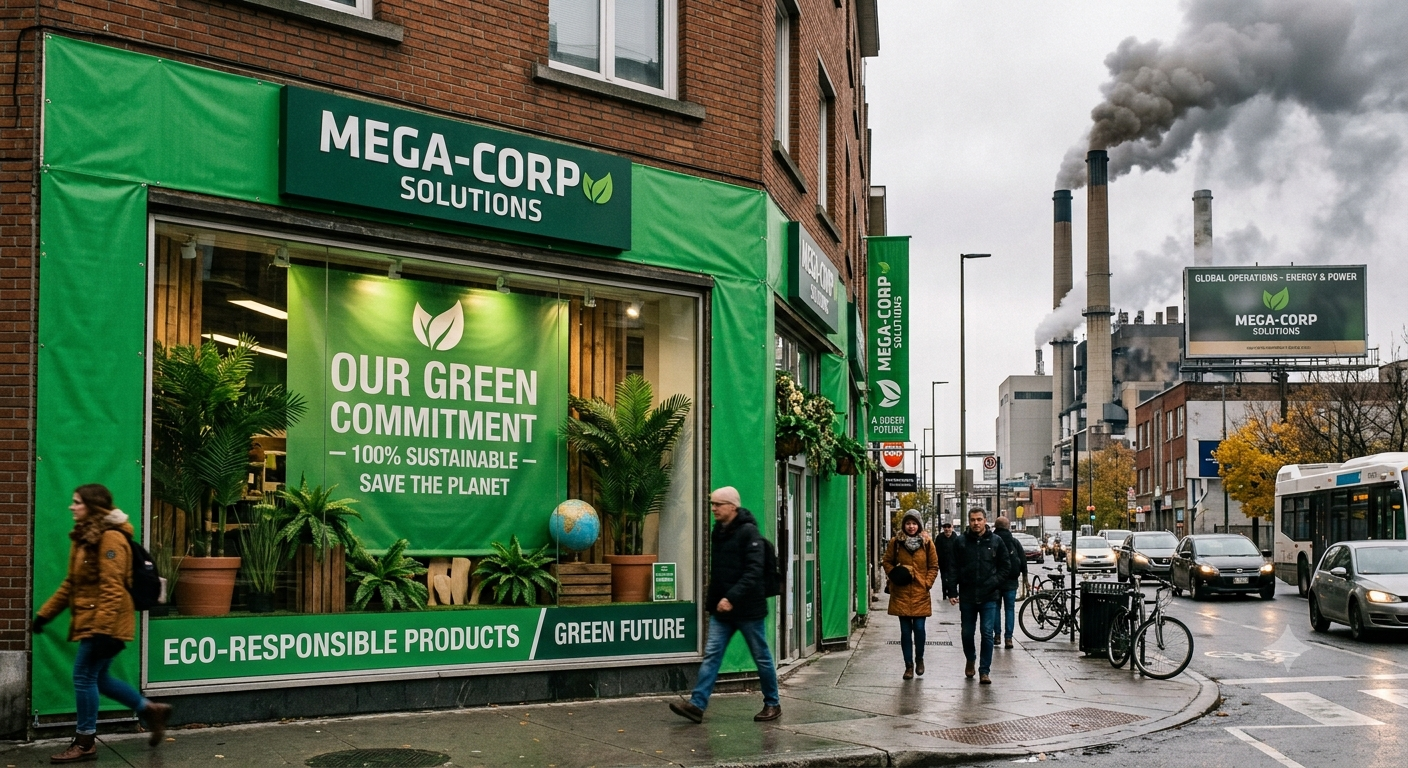
Setting the stage: the green facade
In 2021, the world's largest economies lined up to make history by pledging to reach net-zero emissions by 2050, promising a transformation towards a cleaner, smarter, and more sustainable growth and marking the new era of climate responsibility. Since then, new technologies from carbon capture to hydrogen fuel have been regarded as the foundations of a greener future. Design and innovation have become the symbols of climate leadership.
Yet, as the OECD's 2024 review and KPMG's global analysis reveal, ambition has outpaced achievement. Most countries remain off-track even for their 2030 milestones, and many technologies celebrated as climate solutions are still far from proving their environmental efficacy. The problem is not innovation itself, but when technological promise substitutes for demonstrated impact, the line between genuine progress and greenwashing begins to blur — the paradox of our sustainability age. Greenwashing no longer lies only in marketing slogans; it can emerge within the architecture of innovation and policy. To prevent this, nations and firms must move beyond pledges toward periodic, impact-based assessments, revising their trajectories as evidence evolves. The challenge is to ensure that what we build in the name of sustainability is green not just by design, but by measurable impact.
The term "Greenwashing" — first coined by environmentalist Jay Westerveld in 1986 — refers to the practice of misleading consumers, investors, or policymakers about the environmental benefits of a product, company, or policy. It describes the gap between communicated sustainability and actual environmental performance, turning ecological responsibility into a branding exercise. This definition aligns with the OECD (2022) and the United Nations Environment Programme (UNEP, 2023), both of which frame greenwashing as a form of environmental misinformation that distorts sustainable markets by eroding trust and misallocating capital.
Historically, greenwashing began in marketing campaigns but gradually evolved into a broader strategic phenomenon. For example, Shell faced regulatory findings in 2021 when Dutch authorities ruled that claims such as
"carbon-neutral driving"
via fossil fuel offsets were misleading. Similarly, H&M was sued in the U.S. for allegedly presenting its "Conscious" range as more sustainable, with critics arguing the claims were designed to attract eco-minded customers rather than deliver verifiable impact. As sustainability became a competitive differentiator rather than simply a moral imperative, the illusion of greenness moved upstream, from product packaging and advertising into corporate strategy, national policy commitments, and the architecture of technological innovation.
This article examines how contemporary sustainable technologies risk becoming green by design, and not by impact. While these innovations are crucial and indispensable to any credible decarbonisation path, their portrayal currently often exceeds their actual environmental contribution. By analysing the economic incentives and policy dynamics that sustain this narrative, the discussion aims to reveal how even well-intentioned technological progress can perpetuate a more sophisticated form of greenwashing and why aligning innovation with measurable impact is essential for genuine sustainability.
The mechanics of greenwashing: from signalling to policy systems
Today, being perceived as environmentally responsible has become a distinct economic asset. Firms and governments alike signal "green virtue" because consumers, investors, and policymakers cannot easily verify the true environmental impact of products, technologies, or corporate operations. The appearance of greenness itself can therefore provide competitive and reputational advantage, void of measurable outcomes.
The problem is compounded by information asymmetry. Drawing on the logic of Akerlof's Market for Lemons, when buyers cannot accurately verify environmental quality, markets tend to overreward claims while under-penalizing deception. Firms are incentivized to highlight sustainability in design and marketing. Assessing true environmental performance requires detailed measurement, lifecycle analysis, and verification across complex supply chains — all of which involve high transaction costs, making superficial greenness an attractive, low-cost strategy.
Policy and capital structures further amplify this dynamic. Subsidies, green bonds, tax incentives, carbon credits, and ESG scoring systems often reward the perception of sustainability rather than its actual impact, creating a structural advantage for firms that can signal greenness effectively. Early corporate campaigns exemplify this: Volkswagen's Dieselgate scandal promised low emissions from "clean diesel" vehicles that were later revealed to be rigged.
The new frontier: greenwashing in technologies
In today's climate economy, greenwashing has evolved into a subtler form where technologies are branded as "green" based on design, intent or targets. Emerging technologies are often promoted as the solutions for tomorrow, yet their performance today remains marginal. There is a temporal gap: the benefits of these innovations are expected decades ahead, while emissions, costs and risks accrue now. This presents an intertemporal moral hazard; actors reap reputational or financial gains today by positioning themselves as "green innovators," even though the actual reduction in harm may be uncertain. Some case snapshots:
Large subsidies to carbon capture & storage (CCS) projects may support decarbonisation, yet many facilities capture only a tiny fraction of global emissions. In the hydrogen economy, while "clean hydrogen" is framed as the key to decarbonisation, the dominant production remains fossil-based or costly, meaning the promise of greenness is largely future-oriented rather than current. While EVs eliminate tailpipe emissions, their supply chains (lithium, cobalt, and nickel mining), manufacturing footprint and reliance on grids powered by fossil fuels mean that looking solely at usage hides large upstream impacts. In all these cases, greenness is assumed by intent or by end use evidence, not by full life cycle assessment — a form of optimism arbitrage.
Technological greenwashing is not the work of a single actor but the product of a collective ecosystem: all participate, for their self-interests. Corporations deploy sustainability narratives to secure ESG funds or investor goodwill — without necessarily aligning the full value chain with decarbonisation goals. Governments fund or endorse "green" technologies to signal leadership, promote jobs, or stimulate growth, even when lifecycle standards or verification mechanisms are weak. Investors chase "green tech" as a financial signal overvaluing speculative startups or unproven technologies. Consumers equate "new" or "tech" with "green," often overlooking embedded emissions in supply chains, mining, manufacturing and disposal. Thus, greenwashing persists not because of malice alone, but because it serves the incentives of multiple stakeholders. These technologies are green by design — their engineering logic, investment frameworks and public messaging embody sustainability — but their measured impact often lags behind.
The economics behind the facade
Greenwashing in sustainable technologies is ultimately a symptom of misaligned temporal incentives. Addressing this requires a fundamental shift from design-based validation
"is it labelled green?" to impact-based evaluation "does it demonstrably reduce emissions or resource use over its full lifecycle?"
Policymakers can embed ex-post verification mechanisms into subsidies, incentives, and public funding. Technologies receiving government support could be required to undergo lifecycle carbon audits, and incentives could be tied directly to verified performance. Markets, too, play a critical role. Independent verification, open reporting of technology performance, and harmonised ESG standards can create transparency and reduce information asymmetry. Consumers and investors must cultivate "impact literacy", recognising the lag between innovation and measurable sustainability outcomes.
What we are witnessing is more of an expectations problem. Similarly to speculative bubbles where future value is priced into present behaviour, here future sustainability is priced into present legitimacy. It is no longer enough to focus on the tailpipe (end-use) emissions. The real scrutiny must extend across the entire value chain: from raw material extraction and manufacturing to supply-chain energy, usage, and end-of-life disposal.
Bibliography
1. edie newsroom. (2021). Shell loses court case over carbon-neutral driving claims.
2. Environmental Defence Canada. (2015). Volkswagen Dieselgate timeline.
3. Hydrogen Central. (2021). Mapped: Global hydrogen production by region.
4. Institute for Energy Economics and Financial Analysis. (2021). The carbon capture crux: Lessons learned.
5. KPMG. (2023). Net-zero readiness report 2023.
6. McKinsey & Company. (2022). The race to decarbonize electric-vehicle batteries.
7. OECD. (2022). Environmental performance and greenwashing risks.
8. OECD. (2024). Progress in national climate policy efforts remains insufficient to achieve 2030 targets.
9. OECD. (n.d.). Climate action dashboard. Organisation for Economic Co-operation and Development.
10. UNA. (2021, July 7). EV batteries: Soften the blow of a manufacturing footprint.
11. United Nations Environment Programme. (2023). How green is your brand? UNEP guidelines on environmental claims.