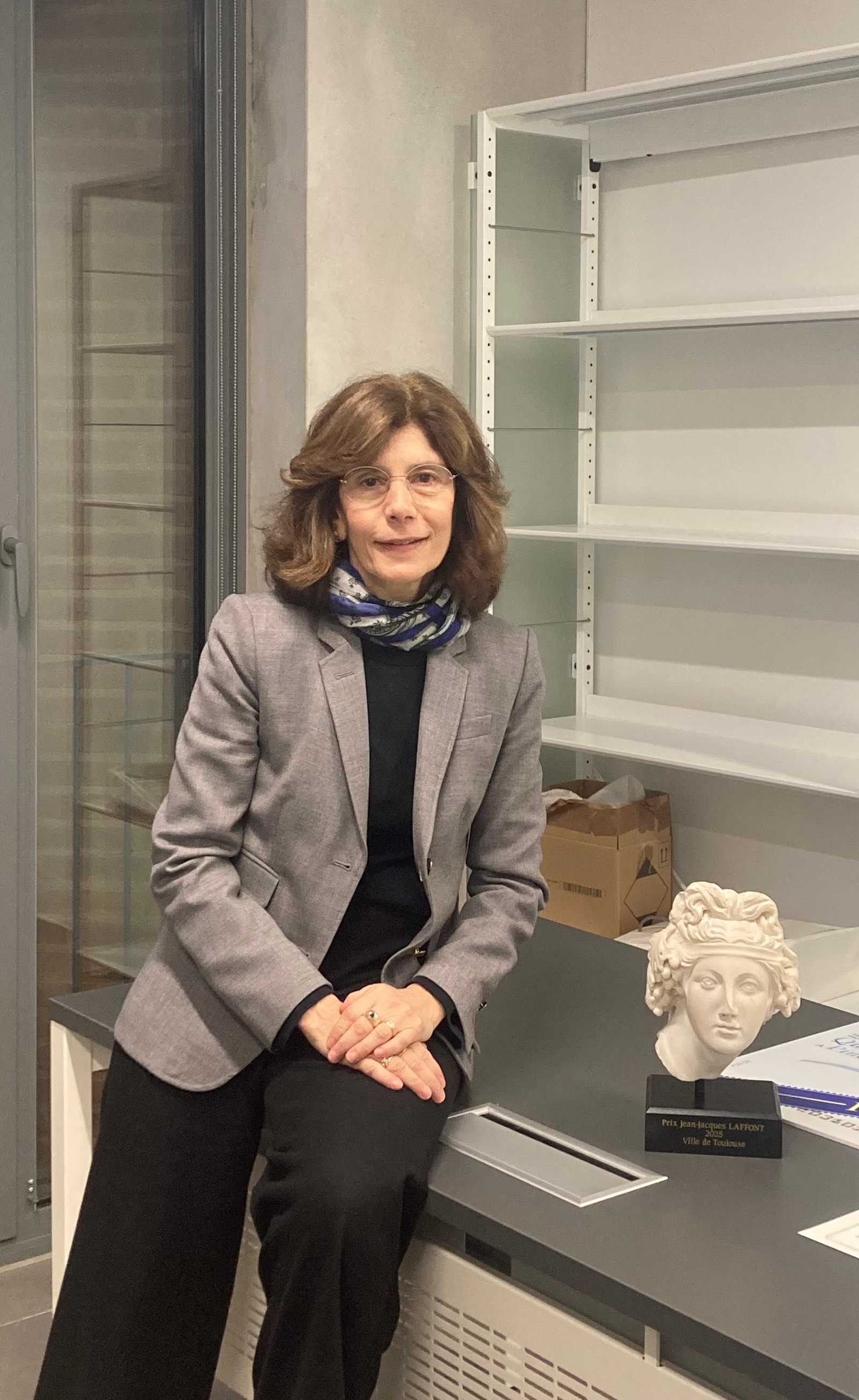
Interviewed by Klara Natek
Jean-Jacques Laffont sought to connect theoretical and empirical reasoning. In your recent work on global trade and economic development, how do you strive to balance analytical rigor and empirical or policy relevance?
Penelopi Goldberg : Relevance comes easily, because development poses many interesting questions today. As I explained in the lecture, we have big structural changes — new technologies, climate change, policy changes, and geopolitical shifts. A natural question that arises is: how will developing countries navigate these changes? The answer is obviously very relevant.
Now, how do we answer this question in a rigorous way? There is often a trade-off between how big or important a question is, and how well you can answer it. Sometimes we do a very good job answering narrow questions and a bad job answering big questions. I have always tried to strike a balance between the two.
When you are confronted with a question, the first thing you do as an economist is to relate it to an appropriate conceptual or theoretical framework. So, in this case, ask yourself, what does theory tell us about how trade, international cooperation, technological progress, and all these things we have enjoyed in the past affect development? To a certain extent, you rely on theory and models, but then you also need to look at the evidence, which means looking at historical data, at what has happened in the past. You try to understand the empirical evidence through the lens of a theoretical framework. That is what I have been trying to do, in a way that combines different methods, given that the questions are very broad and difficult to address.
Your work has shown that trade liberalization can lift many people out of poverty but also deepen inequalities within nations. As the US and other economies are moving towards more protectionist trade models, what kinds of inequalities tend to emerge and who pays the cost?
PG : I think economic historians are going to debate for a long time "why do we have this rise in protectionism" and "why has the whole world turned against open markets". In my opinion, the perception that inequality has risen has played an important role. The most important dimension of this inequality is geographical inequality within countries. Some communities were disproportionately affected by imports, or in other contexts, by immigration. Maybe the economy as a whole benefited from trade and globalization more generally, but the specific communities that were adversely affected mattered politically.
Now, I strongly believe that protectionism is not the answer, especially the latest round coming from the US, which involves high tariffs applied broadly. Tariffs are taxes, taxes on imports, and they tend to be regressive, meaning they fall disproportionately on lower incomes. So although the argument that import competition from low-wage countries has had significant distributional effects is valid, trying to address this concern with tariffs has exactly the wrong effect. It makes the people it is supposed to help worse off.
Yet, some people think that in the long run, trade protection may generate jobs and bring manufacturing back to advanced countries. I do not believe this is going to happen. And, I think that the type of inequality that will increase the most is global inequality. Economies like the United States or Europe's economies are going to suffer from protectionism, but they will be okay. However, poor countries, developing countries have the most to lose. The distance between them and the rest of the world will become even larger. In the past, we managed to reduce global inequality dramatically, but I am afraid that this reduction will stop, and may reverse, so the gaps will become even larger.
In that regard, what could low-income countries that have depended a lot on export-led growth do to react to these tariffs' rise?
PG : One problem with what is going on right now is that no one knows where it will end, because there are constant bilateral negotiations. Developing countries have always complained that even when we had a fairly well-functioning multilateral system, the rules, you can plan accordingly as you know what to expect.
Now, no one knows what to expect, so it is hard to give countries any advice or make predictions. Most countries are being rational, which means being very cautious, trying not to antagonize the big economies, and waiting to see how things will develop.
Still, I think they must realize that in the long run, they will have to rely on their own domestic markets and domestic policies more than ever before. This means the least they can do is adopt sound domestic policies, and this is hard, because many of these countries lack state capacity and proper institutions. In the past, openness, multilateral agreements in particular, provided some discipline on domestic lobbies, and incentives for improving institutions. But this external force is no longer there. I have also made the case that many low-income countries would benefit from increasing the size of the middle class, because the middle class has purchasing power. So it can be a positive force, an engine for growth. One way to do this is through appropriate redistributive policies within countries. This is important as low-income countries can no longer look at external forces to help them grow the way they did in the past.
Part of your recent work explores the link between the effects of international trade and informality. How might renewed protectionism change the landscape for informal workers and firms, especially in developing countries that depend on global value chains?
PG : Informality is a very big issue in developing countries — not just low-income countries, but also middle-income countries. It is a broad term, but essentially, the informal sector is the sector that is invisible to the government. One of the problems with this is, if you do not see the sector, you cannot tax it, and this reduces revenues and state capacity. There are no means to provide funding for public expenditures, improvements in education and so on. So how to deal with informality has been a long-standing concern.
Perhaps surprisingly, openness and trade have had a relatively small effect on informality. Many economies such as Mexico opened their markets and connected to the rest of the world, but still, informality remains a major issue there. For informality, regulation is more important than anything else. Informal sectors exist in many economies because there is excessive regulation, mostly in the labor market, and firms try to get around it. Importantly, regulations are not consistently enforced across all firms — they are enforced only for big firms. Essentially, you tax disproportionately the big firms that tend to be more productive. The work I have done with my coauthors has shown that international trade can alleviate the effects of these "size dependent distortions." Still, in the long run, the best way to address informality is to reduce excessive regulation without completely dismantling regulation — because a certain degree of regulation is needed.
All this has less to do with trade and more with a willingness to take the necessary steps domestically. This is a time when many countries need to do the right thing domestically, rather than looking at external markets for growth.
Having served as chief economist at the World Bank, you have seen firsthand how multilateral institutions try to support developing countries through global crises. What role should these institutions play in the current trade environment?
PG : Sadly, all these multilateral institutions are under attack right now and find themselves in a difficult position. The major stakeholders in these organizations are the large countries, because voting power is proportional to the capital each country has committed. So, multilateral institutions are not sheltered from the geopolitical tensions that we are experiencing. What they can still do is provide advice and technical expertise to countries. For instance, in many countries, there is consensus that domestic reforms are needed. However, countries often do not have the necessary knowledge to implement those, even if they want to. International institutions can help them navigate the necessary changes. Ideally, one would like these organizations to also be the voice of developing countries, but I am not sure if they are willing to step up. It is a difficult position to be in.
Trading and inequality are politically charged topics today. What advice would you like to give to students who want to work at the intersection of trade, development, and policy?
PG : In my opinion, there are many very interesting questions, and research should go after them. Right now, because the world is so volatile and unpredictable, there is a tendency among academics to turn inward and focus on purely academic matters without engaging with contemporary issues. This is in part because no one listens to experts and academics anymore. But we should resist this tendency, because it is exactly in times like this that we are needed.
That said, if you are a student, this is not the time to provide policy advice. You are at an early stage in your career, and you are developing your human capital. While it is great to be motivated by these questions, you need to focus on your classes, on acquiring the right tools, on learning.