When we think about COVID-19, we remember overwhelmed hospitals, deserted streets, businesses calling for help, and households' incomes decreasing. The natural assumption is that such a crisis would have severely impoverished French families.
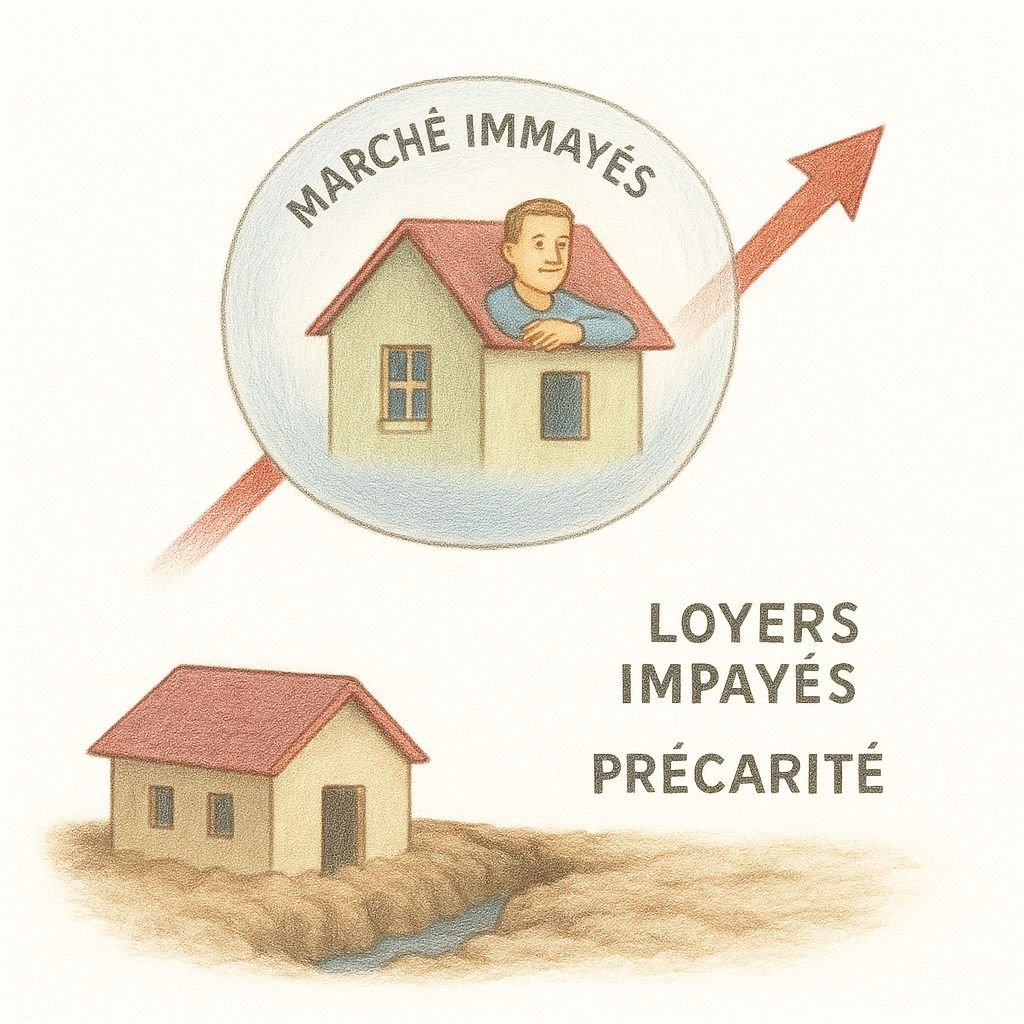
Yet once the shock had passed, the numbers told a far more unexpected story: the net wealth of French households increased from about €12,423 billion at the end of 2019 to €14,616 billion at the end of 2022, a rise of nearly 18%. This surge in household wealth occurred despite modest GDP growth, which rose from roughly €2,391 billion to €2,588 billion (8%), after first collapsing by 7.8% in 2020 before recovering by 6.8% in 2021. This paradox has become a central economic question. How did a crisis that froze activity manage to make households richer? And above all: who captured the gains? A superficial reading might suggest a collective improvement. Reality looks different. The shock that was supposed to weaken everyone instead gave some a decisive head start. Post-COVID France is running in two lanes: more wealth for some, more walls for the rest, a race where the rich get ahead while others get stressed.
A wealth boom during the pandemic: a very unequal upswing
Lockdowns erased a large share of day-to-day spending: travel, leisure, restaurants, transport. Consumption that could no longer occur automatically turned into savings. The household savings rate jumped from 15.1% of disposable income in 2019 to 21.4% in 2020, peaking at 28% during the first lockdown.
But that savings windfall did not benefit everyone equally. According to the French Council of Economic Analysis, the bottom two income deciles were back to their pre-crisis savings levels by early 2022; in other words, their Covid-era surplus was entirely absorbed by daily expenses. Meanwhile, the top 10% preserved a financial surplus worth about 10% of their pre-existing wealth, largely invested in financial accounts that then benefited from the stock market rebound.
The result appeared directly on household balance sheets. In France, real estate dominates private wealth: in early 2021, property represented around 62% of household gross assets. Between 2020 and 2022, property prices soared under historically low interest rates such that owners saw their net worth rise effortlessly, while first-time buyers faced higher income requirements and larger down payments, pushing the entry threshold further out of reach.
Financial markets followed a similar trajectory. After the plunge of March 2020, the CAC40 had already regained pre-pandemic levels by the end of that year and went on to set records in 2021. Yet only a minority benefited from that rally: just 16.7% of households reported owning traded financial assets in 2021. This concentration becomes even clearer when you look at who actually holds them; only about 5% of low-wealth households, barely 15% of those in the middle, and nearly 58% among the wealthiest.
In short, wealth increased overall, but only those who already held assets were able to turn savings into lasting enrichment.
A high level of wealth today… but uncertainty for many
The property boom helped push household wealth upwards in the recovery period, but that phase is now over. Since 2023, the market has flipped: housing transactions dropped to around 928,000 sales in September 2023, from over 1.15 million the year before. Prices turned negative: in Q3 2023, old dwellings in metropolitan France fell by 1.1% quarter-on-quarter and -1.8% year-on-year. Households that bought at the top of the market, often with high leverage, suddenly faced a balance sheet squeeze.
Another concern is inflation. Most of the "Covid savings" remain in low-return bank accounts or regulated savings products that grow in nominal terms but lose real purchasing power as inflation erodes their value. In France, inflation climbed above 6% in early 2023, while risk-free returns lagged well behind. For many modest households, who overwhelmingly rely on regulated savings as their only form of investment, inflation has quietly imposed a real loss.
Access to financing has also become one of the clearest markers of inequality. If a bank rejects a mortgage application, a future asset base disappears. To fight inflation, central banks raised policy rates, with French mortgage rates jumping from 1.1% in early 2022 to over 4% by late 2023. As a result, new mortgage lending collapsed by 40% in 2023 compared with 2022. For modest and younger households, the setback is twofold: borrowing costs are higher, while required down-payments and debt-service ratios exceed tightening regulatory thresholds. As a result, first-time buyers have nearly vanished, and most of the sales in 2023–24 are from homeowners or cash-rich investors.
When housing acted as the main driver of wealth, those without initial capital saw the elevator go up without them. Credit, once a bridge between income and property, has become a gatekeeper.
The risks ahead: a system for a few
Social mobility begins to falter when wealth becomes the entry ticket not only to homeownership, but also to investment, entrepreneurship, and economic security itself. France is sliding toward a model where homeowners raise future homeowners, while those without family capital face shrinking prospects.
When the rate of return on capital exceeds economic growth, as it did in the post-COVID rebound, wealth rises faster than wages, mechanically reinforcing inequalities. As Thomas Piketty argues, in a patrimonial capitalism, opportunity increasingly depends on what you already own… or what you have inherited.
The structure of wealth adds another risk. French household portfolios are overwhelmingly tied to real estate. When a single asset dominates, any correction spreads through the economy. As consequence, confidence falls, consumption weakens, mortgage stress rises, and collateral values shrink, limiting credit capacity at the very moment when households might need it most. In this environment, a housing downturn is not just a market adjustment. Under such market adjustments, it becomes a macro-financial threat.
Meanwhile, France's pandemic safety net came with a cost: public debt has climbed to levels unseen in decades. Funding pro-equity policies, affordable housing, capital support for young households, and incentives for productive investment becomes harder as fiscal space narrows. A deeper challenge emerges: French savings overwhelmingly flow into property rather than innovation or the green transition. Capital is increasingly used to protect the past rather than to finance the future.
Conclusion
COVID-19 did not flatten wealth differences; it fortified their walls. On paper, France exited the crisis richer. In reality, the gains went overwhelmingly to those who already held the right cards. Homeowners became bigger homeowners and investors invested more. Others, unfortunately, watched the opportunities drift further away.
The post-Covid era reveals a silent shift where wealth is no longer the reward of the journey. It has become the ticket to enter the race. The challenge is not to create more wealth. It is to remove the barriers that stop people from building it. The question is not theoretical. It is social, generational, and political: Who gets a seat in the patrimonial society we are now building? Because wealth that belongs only to a few eventually ends up costing everyone.
Bibliography
Autorité des marchés financiers (AMF). Lettre de l'Observatoire de l'épargne, n° 49. Juin 2022.
Autorité de contrôle prudentiel et de résolution (ACPR). N° 160 : Le financement de l'habitat en 2023. Paris : Banque de France, 2024.
Banque centrale européenne (BCE). Wealth Effects on Consumption across the Wealth Distribution: Empirical Evidence. Working Paper Series, n°1817, 2015.
Chauvin, Valérie, et Olivier Damette. "Effets de richesse : le cas français." Économie et Statistique 438-440 (2010) : 111-140.
Institut national de la statistique et des études économiques (Insee). Revenus et patrimoine des ménages – Édition 2024. Paris : Insee Références, 2024.
Notaires de France. Bilan immobilier de l'année 2024. Paris : Conseil supérieur du notariat, 2024.
Piketty, Thomas. Capital et idéologie. Paris : Éditions du Seuil, 2019.
Institut national de la statistique et des études économiques (Insee). Patrimoine et endettement des ménages. Paris : Insee, 2024.