Note: this analysis was written in June 2026 and reflects the information available at that time, some developments may have further impacted this unstable situation.
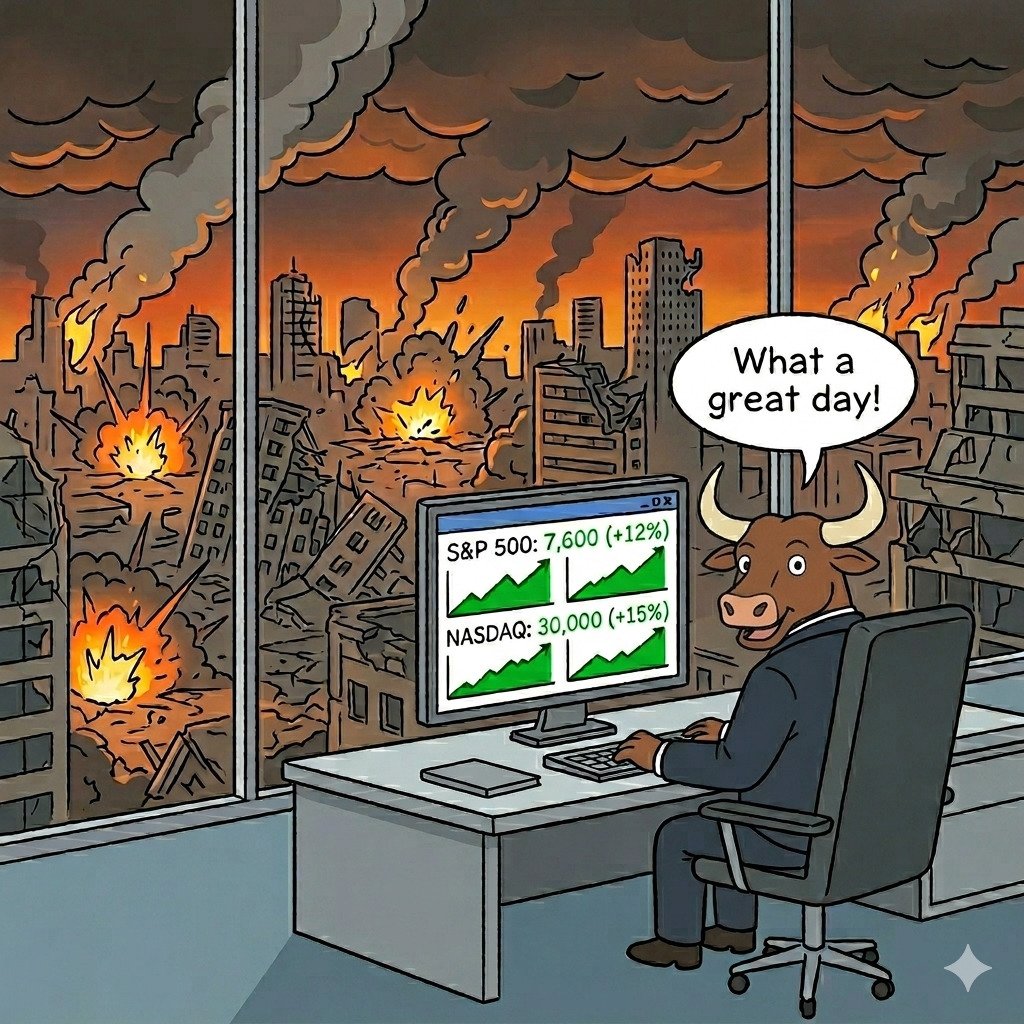
Since February, there has been a war happening in Iran, and it is quite clear it is negatively impacting us Europeans. But something unprecedented is also happening in the financial markets: the US's most traded stocks are hitting all-time highs. The S&P500 closed at 7,600 (03/06/2026), the Dow Jones crossed 51,000 points for the first time in history, and the Nasdaq hit 30,000 points. The US is in a conflict with another country and yet it has recorded 9 consecutive weeks of gains on the S&P500. In this short article, I will put this fragile environment under the microscope.
Last month, Jerome Powell, former chairman of the Federal Reserve, was replaced by Kevin Warsh (1). What is important to keep in mind is that K. Warsh is considered hawkish and in favor of less forward guidance, adding more uncertainty to the US economy. Furthermore, the US Personal Consumption Expenditures index (PCE) (Fed's favorite inflation gauge) has reached 3.8%, and the first quarter growth estimate has been revised downward from 2.0% to 1.6%. The US Institute for Supply Management (ISM) published the Purchasing Managers' Index (PMI), a survey-based indicator measuring business activity in the service sector, where a reading above 50 is a good signal. Its most recent publication surprised with a reading of 54.5, above both the investor expectations at 53.7 and the previous value of 53.6. Thus, since the economy remains robust, increasing the probability of a rate hike to face inflation. Despite the concern over inflation, all the American indexes (Nasdaq, S&P500, Dow Jones) have seen a fantastic bull run over the last 9 weeks.
So, the market should be risk-off, given the war and the alarming data. But we are observing a beautiful bull run. Why? To understand this, one key thing to keep in mind is that financial markets do not price the current economic situation, they price anticipations of future profits. And right now, AI is fueling those anticipations like nothing has in years. Mag7 earnings last month were astonishing: Alphabet's revenue is up by 22% since last Q1, as well as Amazon (+17%) and Meta (+22%). Nvidia reported an 85% YoY increase. AI is delivering and demand is constantly growing. Everything related to AI is exploding: data centers, memory chips, semiconductors, AI infrastructure companies. Investors are perfectly aware of the geopolitical and macro tensions, but they are betting that AI-driven productivity returns will more than compensate for these headwinds down the line. That said, this bull run is far from evenly distributed. The Mag7 now represent approximately 35% of the S&P500, meaning that the apparent strength of the US market is only concentrated among tech giants (2).
Unlike the United States, Europe does not have the technological sector that can carry the broader economy. The Iran war is weighing on the economy: the eurozone Consumer Price Index (CPI), the standard measure of inflation, stands at 3.0% YoY, with energy prices up 10.8% annually, as the Strait of Hormuz is a decisive point for European oil imports (3). The risk of stagflation is now real with the services PMI falling to 46.4, signaling a contraction. The European Central Bank is ready to raise its rates by 25 basis points in June, in order to fight inflation (4). But raising rates in an economy already in PMI contraction risks making the slowdown worse.
China faces several headwinds: fragile domestic demand and US tariffs add further pressure. The Caixin PMI remains resilient at 51.8, meaning Chinese industrial and manufacturing activity is still operating at a robust pace. This has a direct impact on the Australian Dollar but also on industrial materials, copper most notably.
In May, the central Bank of Japan (BoJ) intervened in the financial markets to protect the Japanese yen (JPY) against other currencies (5). The core CPI remains at 1.4% YoY, below the BoJ's 2% target. So, the inflation data does not yet justify a rate hike. The BoJ remains data-dependent and is considering a hike in July, but only if inflation rebounds and the yen stabilizes (6). In the meantime, the carry trade, a strategy where investors borrow in a low-interest-rate currency (here the JPY) and invest in a higher-interest-rate currency (US dollar), remains popular among many institutional investors. By looking at the latest Commitment of Traders report (7), tracking the positions of large speculators, JPY short positions increased by 15,500 contracts, confirming that the market is not yet pricing in a yen reversal.
As for the Canadian Dollar (CAD) currency, why should we care about it? It is a well-known oil (WTI) proxy, meaning that an effect on oil will impact the CAD currency. Furthermore, the Canadian economy depends heavily on exports to the US. Thus, given the current situation, the CAD is in a weaker position. Indeed, with the expectation that the US-Iran conflict will conclude soon, the pressure on oil prices is easing, weighing on the CAD in turn.
In conclusion, the market is in a risk-on phase, ready to jump into the risk-off area at any moment due to uncertainties from the conflict. Europe is directly affected. Thanks to AI and semiconductors, the US continues to gain on its indices, while a rate hike is likely to happen.
This article was not meant to give you financial advice but to briefly analyze the current state of the world in June and how fragile and abnormal the current market environment truly is(8).
Bibliography
(1) Mitra, Anuron. "Kevin Warsh Sworn In as New Fed Chair, Trump Says Wants Him to Be Independent." Investing.com, May 22, 2026. https://www.investing.com/news/economy-news/kevin-warsh-sworn-in-as-new-fed-chair-4707162
(2) Mitra, Anuron. "Magnificent 7 Still Largely Untouched by Tech Rotation, Holding Up Markets." Investing.com, February 4, 2026. https://www.investing.com/news/stock-market-news/magnificent-7-still-largely-untouched-by-tech-rotation-holding-up-markets-4485821
(3) U.S. Energy Information Administration. "World Oil Transit Chokepoints." Accessed March 3, 2026. https://www.eia.gov/international/analysis/special-topics/World_oil_transit_Chokepoints.
(4) Canepa, Francesco, and Balazs Koranyi. "ECB Poised for Insurance Hike as Iran War Fans Euro-Zone Inflation." Reuters, June 11, 2026. https://www.reuters.com/business/ecb-poised-insurance-hike-iran-war-fans-euro-zone-inflation-2026-06-10/.
(5) Okutsu, Akane. "Japan Confirms Record ¥73bn Yen-Buying Intervention in April-May." Nikkei Asia, May 29, 2026. https://asia.nikkei.com/business/markets/currencies/japan-confirms-record-73bn-yen-buying-intervention-in-april-may.
(6) The Yomiuri Shimbun. "Bank of Japan Prepares to Raise Interest Rate to 1.0% at Policy Meeting Next Week, Would Be Highest Level in 31 Years." June 10, 2026. https://japannews.yomiuri.co.jp/business/economy/20260610-331918/.
(7) Tradingster. "COT Reports with Free COT Charts." Accessed June 8, 2026. https://www.tradingster.com/cot.
(8) Forex Factory. 2026. "Economic Calendar." Accessed June 7, 2026. https://www.forexfactory.com/calendar.