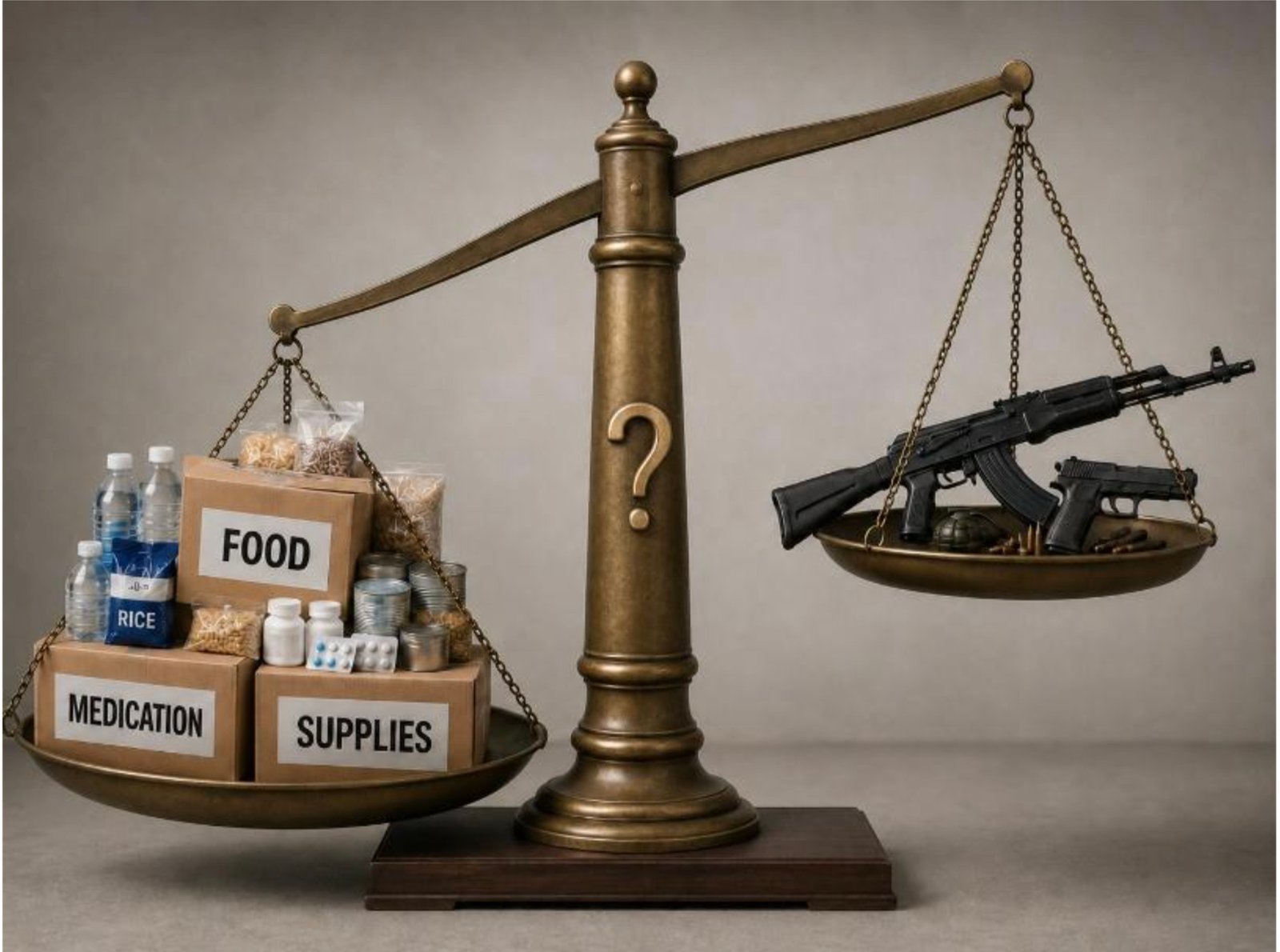
Large amounts of international aid are sent to conflict-affected areas. However, recent cuts to foreign aid budgets across the developed world warrant an investigation into the effects of the remaining aid. This article states that although the general public consensus, and that of early literature, was that conflict aid is entirely positive; the reality may be more nuanced. Recent literature suggests that when aid programmes are not well structured or tailored to the local context, they can increase violence and result in worse economic outcomes for inhabitants. Rather than no aid being sent to conflict affected areas, this suggests that the structure of aid programmes should be carefully considered and tailored to the local context.
Dramatic declines in aid funding to conflict affected areas warrant an investigation into the effectiveness of the remaining aid
Recent reductions in foreign aid have been labelled a "historic decline" by the OECD. Both the UK and Germany have cut development assistance by over 25% since 2023, while the largest cuts in funding have come from the US (OECD 2026). The Trump administration shut down the U.S. Agency for International Development (USAID), causing one of the largest withdrawals of humanitarian and development funding in US history (Oxfam 2026). A significant share of foreign aid is sent to fragile and conflict affected zones (OECD 2025), but if aid to conflict affected areas increases violence, then a more nuanced strategy for international aid is needed. Apart from the direct negative effects of violence, it is well documented that violence worsens other economic outcomes. For example, studies find that a rise in violence increases student dropouts, worsens test scores and increases the number of students repeating grades (Weldeegzie 2023).
The public consensus, supported by early literature, suggests aid is entirely positive
Generally, people believe the effect of foreign aid is entirely positive for the receiving country. Early work by agencies in the field supports this narrative, suggesting that economic aid empowers communities, promotes stability, economic growth and peace (USAID 2007; World Bank 2011).
Early literature supports this view, that aid in conflict zones is almost entirely positive, and finds few negative effects. In a cross-country analysis, Nielsen et al. (2011) find that negative shocks to economic development and welfare aid significantly increase the probability of conflict, while significant positive shocks have little effect. Thus, the paper suggests that if aid must be withdrawn then it should be done carefully and gradually to avoid inciting conflict. Additional micro-evidence is provided by Berman et al. (2011), who find that small scale reconstruction aid from the US significantly reduced violence in Iraq. They suggest that service provision from economic aid helps the community view the state more positively and removes incentives to support insurgents.
However, recent literature finds positive correlations between aid and violence
Although there are compelling reasons to support countries suffering from conflict, the provision of aid can sometimes be counterproductive, as summarised in a quote from Doctors Without Borders:
"We are unable to determine whether our aid helps or hinders … This raises a serious challenge for the humanitarian community: can humanitarians be accused of fuelling or prolonging conflict?" (Kahn and Lucchi 2009)
In that regard, Grossman (1992) developed a theory that aid increases the value of capturing the state for non-state actors (rebels/insurgents). If Grossman's theory is correct, the provision of aid could motivate non-state actors to fight harder to overthrow the current regime, leading to an increase in violence. Any increase in violence is clearly negative for residents and can lead to worse economic outcomes as described briefly above.
There is empirical cross country evidence which provides some support for this theory. Nunn and Qian (2014) use an instrumental variable approach and find that an increase in food aid prolongs conflict and increases conflict intensity. The paper suggests that armed groups are able to steal resources and use them to continue fighting for a prolonged period.
Several other papers provide micro-evidence that aid can increase violence, though in a range of contexts where location specific factors should be considered before generalising results. Dube and Naidu (2015) find that increases in US military aid are associated with higher levels of local violence in Colombia, largely due to resource sharing between the state and paramilitary groups. Additionally, Crost et al. (2014) find that municipalities just eligible for aid experienced higher conflict casualties than comparable ineligible municipalities, potentially because insurgents responded strategically by attempting to undermine the development programme and reduce support for the state.
This section highlights the potential downsides to aid programmes when they are not carefully structured, and the importance of considering the local context before providing aid.
This does not suggest that aid should not be sent to conflict affected countries, but that aid programmes must be carefully structured
Some more recent literature recognises that to maximise the benefits and avoid the negative impacts of aid, programmes need to be better structured and tailored to the local context. For example, Wood and Molfino (2016) find that increases in humanitarian aid are correlated with increases in conflict but other forms of aid are not. Moreover, Lilja et al. (2025) find that the composition of aid is important for avoiding conflict relapse, as countries with more aid devoted to peacebuilding are less likely to relapse (though the paper states that further work is needed to identify causation). Further work by Berman et al. (2013) finds that aid can reduce violence to a greater extent when projects are smaller, guided by development experts, and are valued by the community. The paper also suggests that aid is more effective in Iraq when troop presence is strong, suggesting that strong local institutions are also important.
This is further supported by Burnside and Dollar (2000) who find that aid has a positive impact in developing countries with good fiscal, monetary and trade policies prior to receiving the aid, but has little effect in countries with weak institutions.
Conclusion
The main take-away is that aid packages should be carefully designed so that they target a specific outcome and account for the local context, while trying to minimise the propensity to increase violence. For example, sending military aid to Colombia may be more likely to incite additional violence given the links between the Colombian state and paramilitary organisations (Dube and Naidu 2015), whereas more carefully considered aid packages may have been more helpful.
Bibliography
Berman, Eli, Jacob N. Shapiro, and Joseph H. Felter. "Can Hearts and Minds Be Bought? The Economics of Counterinsurgency in Iraq." Journal of Political Economy 119, no. 4 (2011): 766–819.
Berman, Eli, Joseph H. Felter, Jacob N. Shapiro, and Erin Troland. "Modest, Secure, and Informed: Successful Development in Conflict Zones." American Economic Review 103, no. 3 (2013): 512–17.
Burnside, Craig, and David Dollar. "Aid, Policies, and Growth." American Economic Review 90, no. 4 (2000): 847–68.
Crost, Benjamin, Joseph Felter, and Patrick Johnston. "Aid Under Fire: Development Projects and Civil Conflict." American Economic Review 104, no. 6 (2014): 1833–56.
Dube, Oeindrila, and Suresh Naidu. "Bases, Bullets, and Ballots: The Effect of US Military Aid on Political Conflict in Colombia." The Journal of Politics 77, no. 1 (2015): 249–67.
Grossman, Herschel I. "Foreign Aid and Insurrection." Defence Economics 3, no. 4 (1992): 275–88.
Kahn, Clea, and Elena Lucchi. "Are Humanitarians Fuelling Conflicts? Evidence from Eastern Chad and Darfur." Humanitarian Exchange Magazine, no. 43 (2009): 20–23.
Lilja, Jannie, Tobias Lindé, Abeer S. Ahmad, and Gary Milante. "Foreign Aid Composition and Sustaining Peace After War." Journal of Peacebuilding & Development 20, no. 3 (2025): 325–45.
Nielsen, Richard A., Michael G. Findley, Zachary S. Davis, Tara Candland, and Daniel L. Nielson. "Foreign Aid Shocks as a Cause of Violent Armed Conflict." American Journal of Political Science 55, no. 2 (2011): 219–32.
Nunn, Nathan, and Nancy Qian. "US Food Aid and Civil Conflict." American Economic Review 104, no. 6 (2014): 1630–66.
OECD. States of Fragility 2025. Paris: OECD Publishing, 2025.
OECD. "A Historic Decline in Foreign Aid: Preliminary 2025 ODA Data." OECD, April 9, 2026.
Oxfam America. "What USAID Did, and the Effects of Trump's Cuts on Lifesaving Aid." Oxfam America, January 27, 2026.
U.S. Agency for International Development. Community-Based Development in Conflict-Affected Areas: An Introductory Guide for Programming. Washington, DC: USAID, 2007.
Weldeegzie, Samuel G. "The Persistent Effect of Conflict on Educational Outcomes: Evidence from Ethiopia." International Journal of Educational Development 103 (2023): 102884.
Wood, Reed M., and Emily Molfino. "Aiding Victims, Abetting Violence: The Influence of Humanitarian Aid on Violence Patterns During Civil Conflict." Journal of Global Security Studies 1, no. 3 (2016): 186–203.
World Bank. World Development Report 2011: Conflict, Security, and Development. Washington, DC: World Bank, 2011.