
This piece comes out of my graduate research on how competition law works in practice in India. I want to start not with the law itself, but with a loaf of bread.
Through the 1990s and into the 2000s, a small group of companies that between them baked most of South Africa's bread secretly agreed to push their prices up together. When the country's competition regulator finally broke the scheme open, its tribunal summed up the damage in one line: it was the poorest South Africans who had ended up paying more for their daily bread than anyone else.
This aspect is crucial to understand why competition law is not an abstraction in the developing world.
This finding explains why competition law exists at all, and why it matters most in exactly the places it was once assumed to matter least. In wealthy economies, antitrust can look like a technical duel between big firms and clever lawyers. In a developing economy, a cartel that fixes the price of bread, cement or medicine is a private tax on the people least able to absorb it. Markets are younger and often dominated by a few entrenched incumbents; consumers run on thin margins and have few alternatives. When a handful of firms decide to collude rather than compete, the cost falls hardest on the very people the economy is meant to be lifting up.
This is why, over the past two decades, country after country in the developing world has built itself a competition authority. India created its Competition Commission, the CCI, under a 2002 law that began serious enforcement around 2009. Brazil, South Africa, Pakistan, Kenya and dozens of others did much the same. The logic is identical everywhere: as an economy opens up and grows, it needs a referee to stop its largest players from simply carving the field up among themselves.
India is a useful place to test that logic. Working on my thesis on how these laws are actually enforced there has been illuminating.
Having a competition watchdog and having one that actually bites are two very different things.
The gap between the two is where the real story of antitrust in the developing world is being written.
On paper, India's regime looks formidable. Under Section 27 of its Competition Act, the CCI can fine a cartel up to ten per cent of its turnover. Yet when I traced what happened to the firms it actually penalised, matching fifteen years of the Commission's orders against company financial records, I found something deflating. By every financial measure I could test, a CCI penalty left no detectable mark on the firms it hit. Their sales, profits and assets carried on almost exactly as if nothing had happened.
The instinctive explanation is that the fines are simply too small. That is part of it. The penalty is rarely reduced; it is deferred, and the deferral runs for years. It jumps from the CCI to appellate tribunals, back to the CCI and often to the Supreme Court.
Consider one case I studied closely. In 2018 the CCI broke up a cartel that had rigged the bids for waste-collection contracts in the Indian city of Pune, fining the firms at the maximum ten-per-cent rate. The companies appealed to the national tribunal that hears competition cases. That tribunal did not rule until the end of 2022, and even then it sent several of the appeals back to the CCI to be recalculated. The dispute then climbed to the Supreme Court, which did not finish with it until 2025. Seven years after the original order, the CCI recomputed the fines and arrived at almost precisely the figures it had set in 2018. The penalty was never overturned. It had simply hung in the air, unpaid and unresolved, for the better part of a decade.
Multiply that across the system and it starts to add up. Of the appeals I was able to track, roughly half were still unresolved seven years after they were filed.
This aspect is crucial to see just how long enforcement is suspended in mid-air.
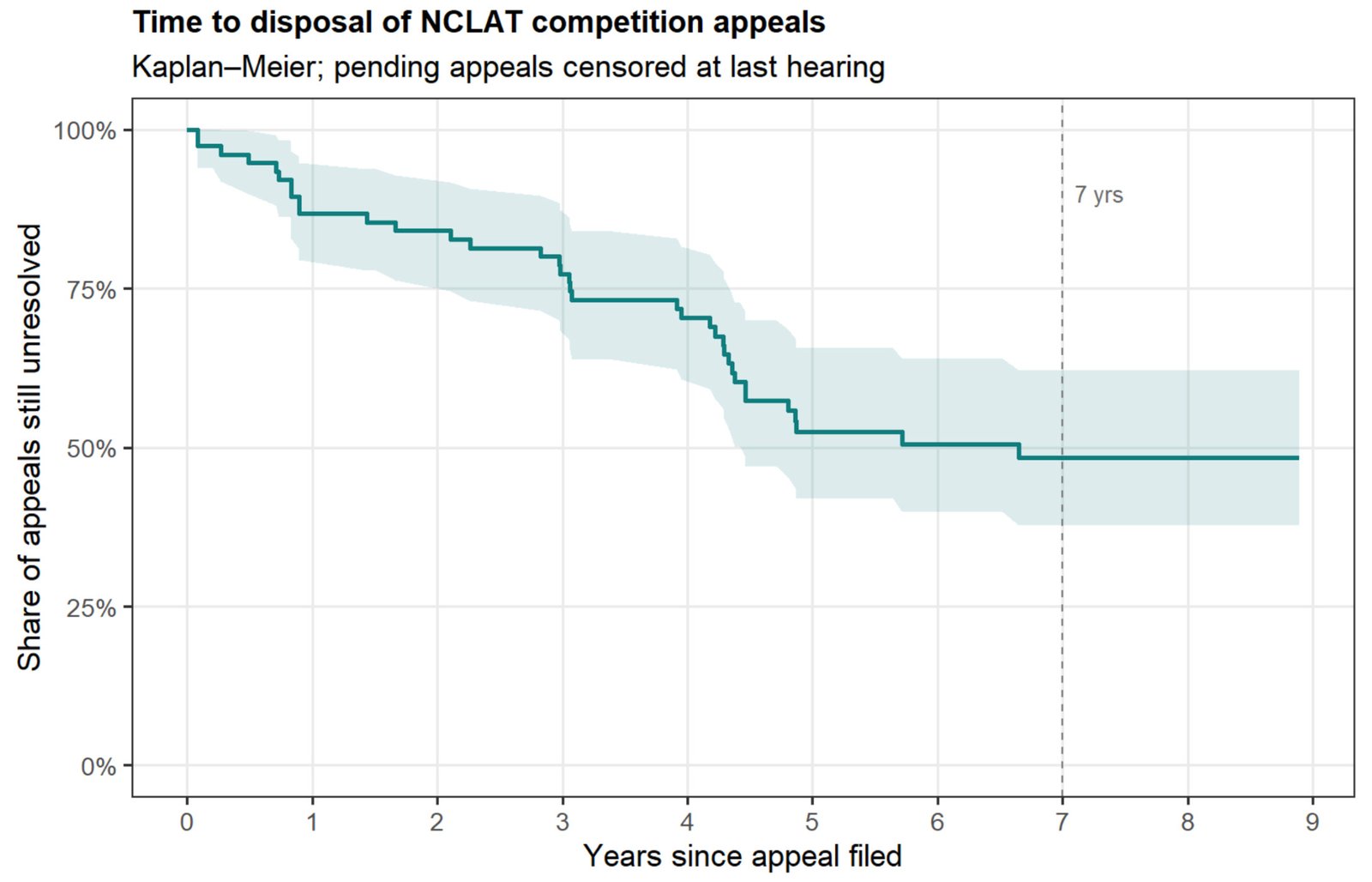
While an appeal sits pending, collection of the fine is usually frozen. A penalty you might finally pay in 2032 for something you did in 2018 is, in any meaningful economic sense, hardly a penalty at all.
This is not an Indian quirk. Reviews by bodies such as the OECD and UNCTAD of the world's younger competition agencies keep flagging the same handful of constraints: thin budgets, scarce specialist expertise, political resistance and entrenched vested interests. The same story surfaces from Bangladesh to Zambia.
Writing a tough-sounding competition statute turns out to be the easy part. Building the institutions that can enforce it, tribunals that resolve cases in months rather than years, is the hard part, and the part most often left half-finished.
That is the lesson for every young antitrust regime, India's included: institutions, institutions, institutions. A fine that lands seven years late, after the firm has long since moved on and the public has stopped watching, deters almost nobody.
Bibliography
Makhubele, Decide. "Fighting over Breadcrumbs: Cartels and the Competition Act 89 of 1998." De Rebus, March 2014. https://www.derebus.org.za/fighting-breadcrumbs-cartels-competition-act-89-1998/.
South African Government. "Findings of the Competition Commission Following Revelations by Premier Foods." March 16, 2010. https://www.gov.za/news/media-statements/findings-competition-commission-following-revelations-premier-foods-16-mar.
CUTS International. "Challenges Faced by Small Agencies and Those in Developing Economies." Contribution to the OECD Global Forum on Competition, DAF/COMP/GF/WD(2017)23, November 28, 2017. https://one.oecd.org/document/DAF/COMP/GF/WD(2017)23/en/pdf.
UNCTAD. "International Cooperation in Competition Law Enforcement: Challenges and Opportunities for Younger and Smaller Agencies in Developing Countries and Countries with Economies in Transition." Background note, Ad-Hoc Expert Group Meeting on Competition Law and Policy, April 8, 2019. https://unctad.org/system/files/official-document/ahm2019_1_background_en.pdf.