Artificial Intelligence (AI) is advancing very fast, consistently outpacing experts' predictions. The big AI labs — OpenAI, Anthropic, DeepMind — believe this rate of improvement is going to continue into the future until, soon enough, they develop systems capable of performing every economically valuable task as well as a human would. AI experts predict that widespread unemployment and a fall in wages would follow the development of this powerful AI, typically called Artificial General Intelligence (AGI).
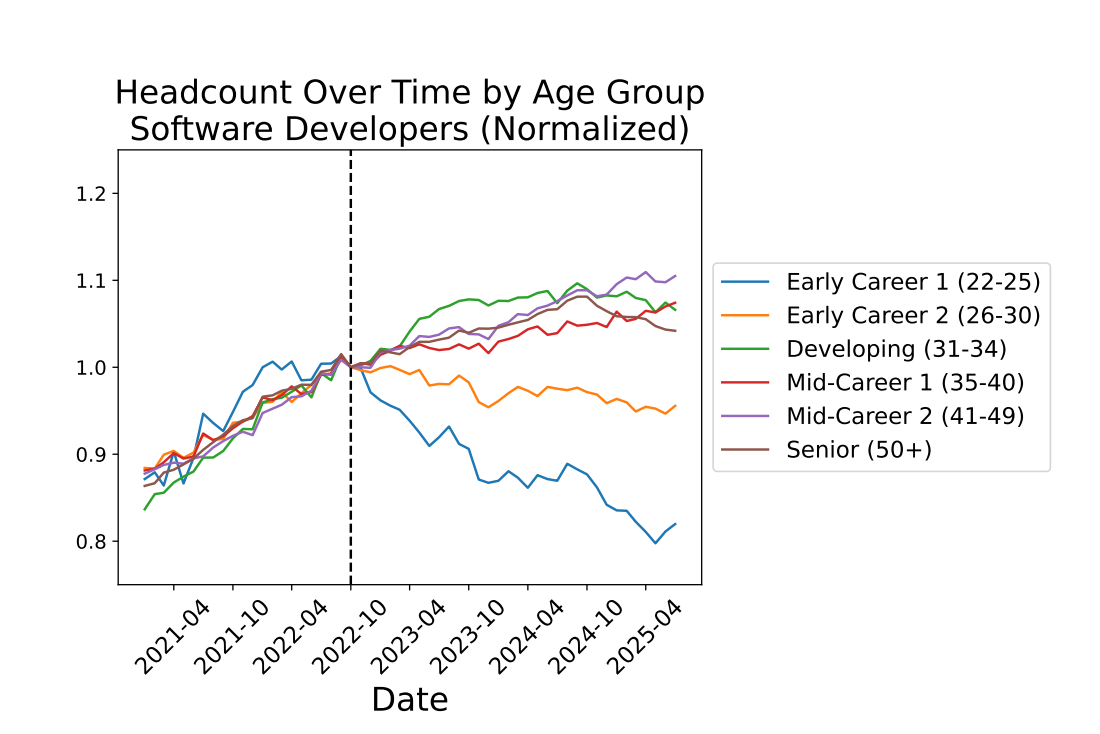
Despite the gloomy predictions, so far, the impacts of AI on the labor market seem to have been very modest. AI-exposed occupations have not seen significant changes in hiring at the aggregate level, either in the US or in Denmark. There is one important exception, however: employment has fallen in more AI-exposed occupations for 22-25 year olds. This is true for the US and for the UK. As the authors of these papers argue, it seems plausible AI is really behind this decrease in employment for young workers.
One interpretation of the data is that current AI systems are substitutes for younger workers, while they are complements to more experienced, older workers. Let's suppose this view is correct. What would its implications be for inequality inside the firm?
Basic labor market models would predict that, as AI systems become better and cheaper, those inputs who are substitutes with them would see a decline in labor demand, which in turn would lead to lower employment and wages. On the other hand, any input which is a complement to AI would become more productive and, in turn, equilibrium employment and wages would increase. Thus, inequality between experts and novices inside the firm would increase, at least until the novices become experts themselves.
But here's the issue: how are novices going to become experienced if they are not getting hired? The basic labor market model might be underestimating the impact of inequality between young and older workers due to the nature of apprenticeship.
In the pre-AI world, young workers and firms faced a problem of general training. Why would firms pay for training a novice if they can just walk out of the firm and work for some other company with their newly acquired productivity? As general purpose knowledge is noncontractable, the solution to this problem involves a long process of apprenticeship where novices are paid wages below their productivity to subsidize their own training. This way, it is the novice who pays for the acquisition of knowledge, making it profitable for the firm to train him even if he later leaves.
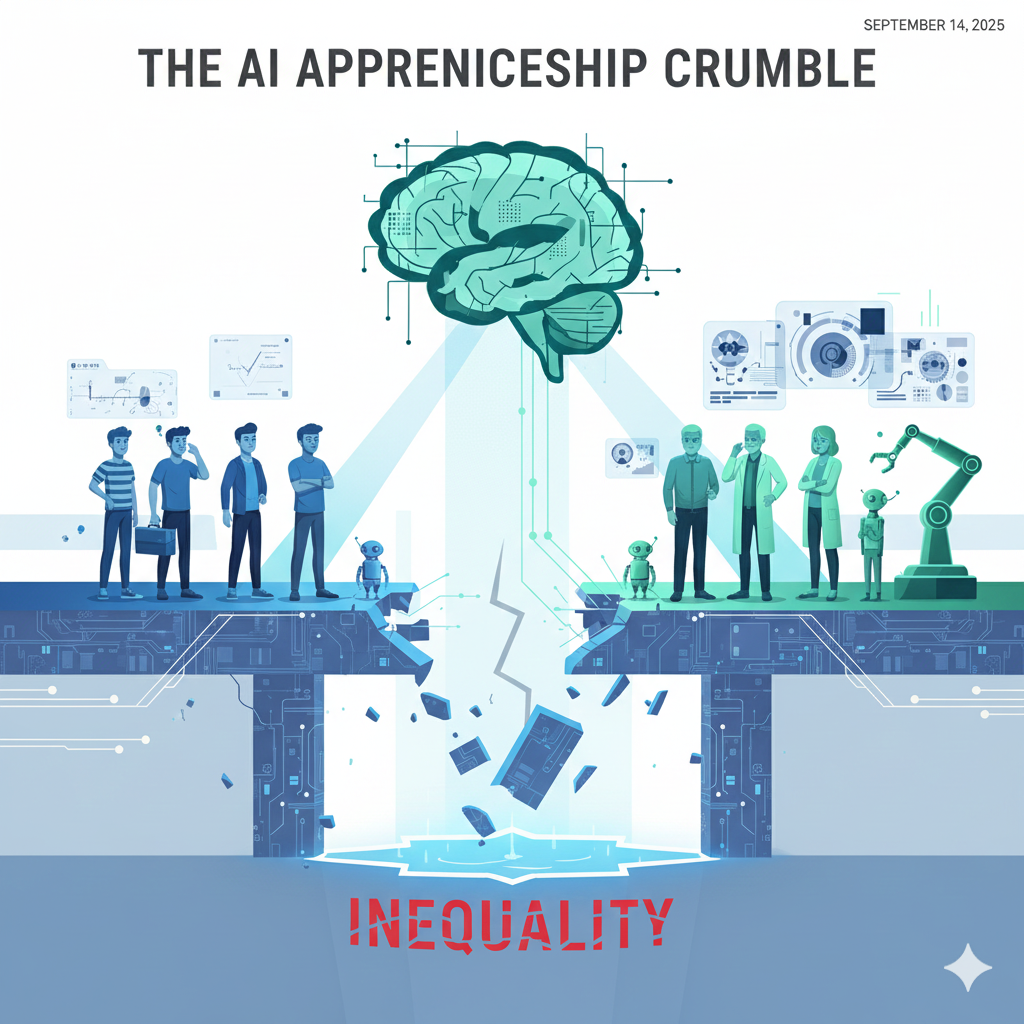
This whole structure assumes that the novice, despite his low level of expertise, is capable of producing revenue for the firm. But remember our premise: AI can now substitute for the work of entry-level, low-expertise workers. And if young workers are not productive enough to be hired for an apprenticeship, then the careful bridge to becoming an expert — who does benefit from AI — suddenly crumbles. In other words, AI threatens to create a wide gap between experts and non-experts, between young and older workers, wider than a simple model would anticipate.
How can this problem be solved? Garicano offers some guidance. One possibility is changing the incentive structure for firms, so that it becomes viable again for them to hire novices for training. This could be done either through public subsidies, like Singapore's SkillsFuture scheme, or through industry-level consortiums that share the costs of apprenticeships among firms. A complementary solution involves changing the education curriculum. If novices enter the labor market with skills AI cannot directly substitute for, they can become productive enough for the firm to hire them, starting the learning process to become senior workers.
All these solutions seem worth exploring, and changing the education curriculum seems inevitable. However, we should be careful with supporting costly policies when the environment is so uncertain. The biggest uncertainty at the moment is how far AI will improve in its capacity to perform economically valuable tasks. Our best measures suggest it will keep improving, and many experts in the AI industry expect above-human-level systems to be developed soon. If this is the case, then even senior workers may be threatened in the near future, in a way that makes training for these roles futile. We should, thus, be willing to entertain more radical scenarios and plan for them as well, choosing among the policy options that are more robust across different paths. Only in this way we can safely navigate this new "intelligence age".
Bibliography
(1) Stanford Digital Economy Lab. "AI and labor markets: What we know and don't know." Last modified October 14, 2025.
(2) Chandar, Bharat. "Tracking Employment Changes in AI-Exposed Jobs." June 03, 2025.
(3) The Budget Lab at Yale, Yale University. "Evaluating the impact of AI on the labor market: The current state of affairs." Last modified October 1, 2025.
(4) Economic Innovation Group. "AI and jobs: The final word." Last modified August 10, 2025.
(5) Jacob Dominski & Yong Suk Lee, 2025. "Advancing AI Capabilities and Evolving Labor Outcomes." Arxiv Papers.
(6) Humlum, Anders and Vestergaard, Emilie. "Large Language Models, Small Labor Market Effects." April 15, 2025. University of Chicago, Becker Friedman Institute for Economics Working Paper No. 2025-56.
(7) Stanford Digital Economy Lab. "Canaries in the coal mine." Stanford University. Last modified August 2025.
(8) Gans, Joshua. Substack. "If AI and workers were strong complements." Last modified August 30, 2025.
(9) Garicano, Luis. Substack. "The AI Becker problem. Silicon Continent." Last modified 23 July, 2025.
(10) OpenAI. "GDP-Val: Measuring AI's contribution to economic growth." Last modified 25 September, 2025.
(11) METR. "How does time horizon vary across domains?" Last modified 14 July, 2025.
(12) Amodei, Dario. "Machines of loving grace." Last modified October 2024.
(13) Altman, Sam. "The gentle singularity." Last modified 10 July, 2025.
(14) Kokotajlo et. al. "Scenarios for the future of artificial intelligence." Last modified April 3, 2025.
(15) Ajay K. Agrawal, Joshua S. Gans, and Avi Goldfarb. "Genius on Demand: The Value of Transformative Artificial Intelligence." NBER Working Paper 34316 (2025).
(16) Altman, Sam. "The Intelligence Age." Last modified 23 September 2025.